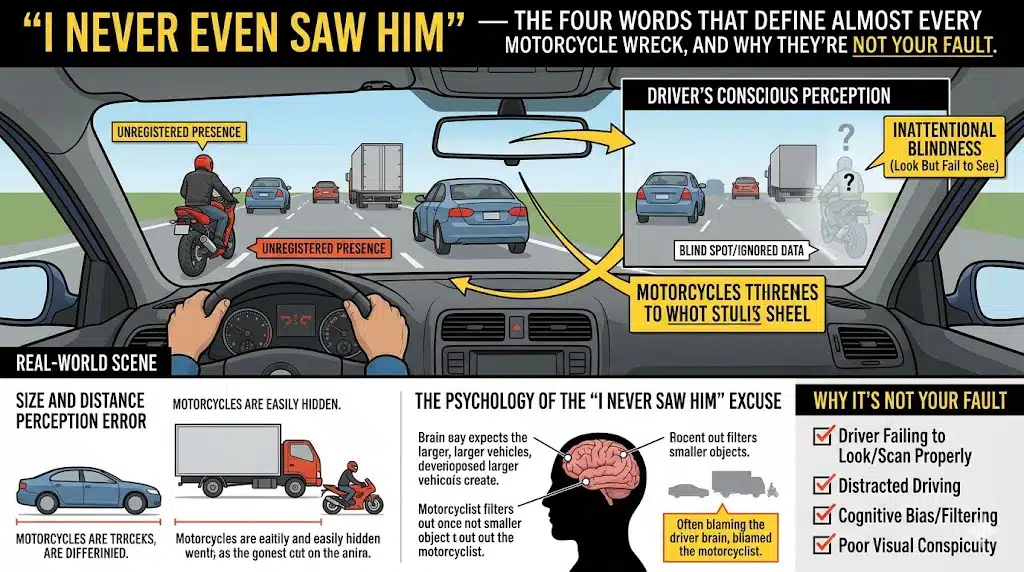
It is a clear afternoon on a two-lane East Texas highway. You’re in your lane, headlight on, doing everything right. Ahead, a sedan waits to turn left across your path. You make eye contact — you’d swear you did. Then the car turns. Right into you. There is no time to brake, only to brace.
In the ambulance, or later in the ER, you’ll hear what the driver told the officer: “I never even saw him.” It’s the most common sentence in motorcycle crash investigations. And here is what every rider needs to understand: their failure to see you is not your failure. It is theirs. But if you don’t act fast, their insurance company will spend the next several months trying to convince everyone otherwise.
Your Real Opponent Is the Insurer’s Oldest Trick: Blame the Biker
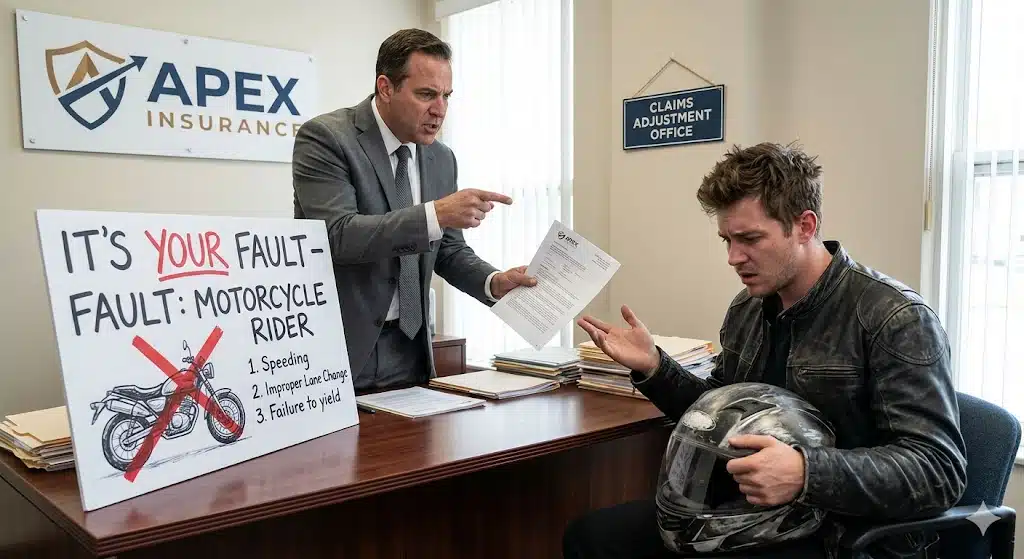
Riders carry a target the moment a claim is filed. Insurance adjusters know that jurors, and the public, often arrive with a quiet bias — that motorcyclists are reckless, that they speed, that they “had it coming.” Adjusters don’t fight that prejudice. They feed it.
So instead of focusing on the driver who turned left across your lane, the insurer goes to work on you. Were you speeding? Were you lane-splitting? Were you wearing a helmet — and if not, doesn’t that prove you’re careless? Were your “loud pipes” a sign of an aggressive rider? None of these questions is really about what happened. They are about manufacturing comparative fault — shifting a slice of the blame onto you — because in Texas, every percentage point of fault assigned to you cuts what you can recover, and if they can push you past the halfway mark, you recover nothing at all.
This is why motorcycle claims are different from any other crash. The physics, the injuries, and the law all matter — but the first battle is the story, and the insurer starts that battle assuming you’ll lose it.
What McKay Law Does the Moment You Call — Built for Riders
McKay Law handles motorcycle cases the way they have to be handled: by attacking the “blame the biker” narrative before it sets. We are a Texas personal injury firm with attorneys who understand motorcycle dynamics — sightlines, braking, the left-turn geometry that causes so many of these wrecks — and we move fast, because the evidence that proves the driver’s fault disappears within days.
Our team takes over the insurer’s calls so you never give an unguarded statement. We pull the crash report, lock down the scene evidence, secure any camera footage before it’s overwritten, and preserve your bike and gear instead of letting them be scrapped. We document the full scope of catastrophic injuries — road rash, fractures, traumatic brain injury, spinal damage — with the right specialists, and we build the liability case the insurer respects. We’ve recovered millions for injured Texans, we work on contingency, so there is no fee unless we win, and we handle your property-damage claim at no charge. See how our rider-focused approach works, or our Texas motorcycle accident practice.
Key Takeaways
- “I didn’t see you” is an admission, not a defense. A driver’s duty is to see and yield; failing to is negligence.
- Left-turn and intersection crashes dominate. According to TxDOT, a large share of motorcycle fatalities happen at intersections, often when a vehicle turns across a rider’s path.
- The insurer will try to blame you — speed, lane position, helmet, gear — to assign comparative fault. Don’t hand them the material.
- Don’t give a recorded statement to the at-fault driver’s insurer before talking to your own attorney.
- You can recover even if partly at fault — as long as you were 50% or less responsible. Past that, Texas bars recovery entirely.
- Helmet law is age-based. Riders under 21 must wear one; many adults are exempt — but whether helmet use affects a claim is a fact-specific legal question, not an automatic bar.
- Preserve the bike and gear. They’re evidence. Don’t authorize repairs or scrapping until your case is documented.
- The deadline is generally two years, but the evidence clock runs in days.
The Evidence Chain: What Actually Proves the Driver Was at Fault
The short answer: a motorcycle case is won by rebuilding the seconds before impact with hard evidence, because the rider rarely gets to tell the story and the other driver almost always says they “didn’t see” anything. Lock the chain down early and the truth holds; let it erode and it becomes your word against theirs. Here’s the chain, in the order it matters.
1. The crash report (CR-3). When police respond to a Texas crash involving injury, death, or roughly $1,000+ in damage, the officer files a Texas Peace Officer’s Crash Report with a diagram and often an opinion on fault. You can obtain it through TxDOT’s Crash Reports and Records system, and it’s frequently the spine of a liability argument.
2. Scene geometry and sightlines. In a left-turn or failure-to-yield case, the angles are everything: where each vehicle was, the line of sight the driver had, the point of impact, the gouge marks and debris. A reconstruction expert can use these to show the driver had time and a clear view to see you — and didn’t yield.
3. The other vehicle’s data and damage. Many cars carry an event data recorder capturing speed and braking. Combined with crush patterns, it can establish who was where, how fast, and whether the driver braked at all. This is lost if the car is repaired before it’s examined.
4. Camera footage. Your helmet-cam or bike-cam, the driver’s dashcam, a nearby business’s security camera, or a traffic camera may have captured the whole thing. Most footage is overwritten within days, so it has to be requested immediately.
5. The motorcycle and your gear. Your bike’s damage tells the impact story, and your helmet and gear can document both the force involved and that you took safety seriously. Preserve them — do not let an insurer total and crush the bike before it’s been examined.
6. Independent witnesses. Witnesses with no stake in the outcome are powerful, especially when they confirm the driver turned across your lane. Their contact information is easy to collect at the scene and nearly impossible to recover later.
7. Medical records. Motorcycle injuries are often severe, and they must be documented and treated consistently from the start. The records connect the crash to your harm and establish the full value of the claim — including future care.
The pattern holds as in any serious case: the evidence is fragile, the clock is running, and the side that controls the narrative early usually controls the outcome.
Where These Wrecks Happen: East Texas and the DFW Metroplex
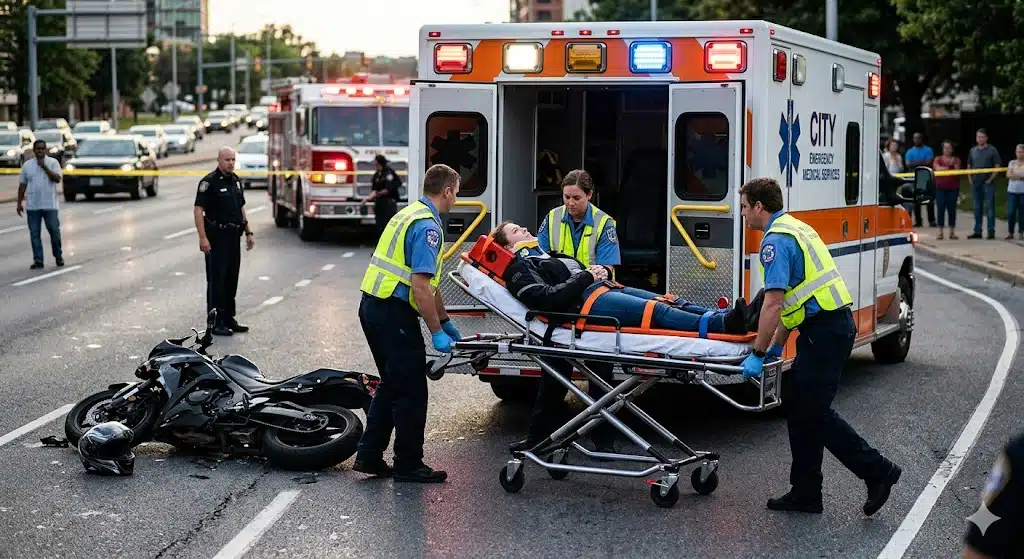
Riding in Texas carries outsized risk. According to NHTSA, per mile traveled, motorcyclists are roughly 27 times more likely to die in a crash than people in passenger cars and nearly five times more likely to be injured. TxDOT’s Share the Road: Look Twice for Motorcycles campaign reports that around two riders die on Texas roads every day, with a large share of fatalities occurring at intersections — exactly the left-turn scenario that produces so many claims.
In East Texas, the danger is a mix of high-speed rural highways — I-20, US-59, US-271, US-69 — open farm-to-market roads where gravel, curves, and inattentive drivers turn deadly, and in-town intersections and loops like Loop 323 in Tyler. McKay Law’s roots are here, with offices in Sulphur Springs and Tyler and clients across Hopkins, Hunt, Smith, Gregg, and Rusk counties and towns from Longview and Mount Pleasant to Paris, Greenville, and Texarkana.
In the DFW Metroplex, the danger is traffic density and drivers who simply aren’t looking for bikes. Lane changes and left turns on I-635 (LBJ), I-35E, I-30, the Dallas North Tollway, and the suburban arterials catch riders constantly. With a Dallas office, McKay Law represents injured riders throughout Dallas, Collin, Denton, Rockwall, and Tarrant counties — including communities like McKinney.
Whether your wreck was on a quiet FM road or in Metroplex traffic, the driver’s “I didn’t see you” and the insurer’s effort to blame you are the same — and so is the urgency of preserving your evidence.
Frequently Asked Questions
The driver said they “didn’t see me.” Doesn’t that hurt my case? Just the opposite. Drivers have a legal duty to see what’s there to be seen and to yield. “I didn’t see the motorcycle” is generally an admission of inattention — evidence of the driver’s negligence, not yours.
Was I required to wear a helmet in Texas, and does it affect my claim? Under Texas Transportation Code § 661.003, riders and passengers under 21 must wear a DOT-compliant helmet, with no exceptions. Riders 21 and older may ride without one if they have completed a DPS-approved motorcycle safety course or carry qualifying health insurance. Insurers often argue that not wearing a helmet increased your injuries, but whether that actually reduces a recovery is a fact-specific legal question — not an automatic bar to compensation. Discuss your situation with an attorney before assuming it counts against you.
Can I still recover if I was partly at fault? Often, yes. Texas uses modified comparative fault under Civil Practice and Remedies Code § 33.001: you can recover as long as you were 50% or less responsible, with your recovery reduced by your share of fault. If you’re found more than 50% at fault, you recover nothing — which is exactly why insurers work so hard to pin blame on riders.
How long do I have to file a motorcycle accident claim in Texas? Generally two years from the crash, under Texas Civil Practice and Remedies Code § 16.003. But evidence and witnesses fade in days, so the practical time to act is immediately.
What if the driver who hit me had no insurance or too little? Texas only requires minimum liability coverage, which is often far too little for the catastrophic injuries common in motorcycle wrecks. If the at-fault driver is uninsured or underinsured, your own uninsured/underinsured motorist (UM/UIM) coverage may step in. The Texas Department of Insurance auto insurance guide explains these coverages.
Should I let the insurance company total and pick up my bike? Not before it’s been examined. Your motorcycle is evidence — its damage helps prove how the crash happened. Once it’s repaired or crushed, that proof is gone for good.
What does it cost to hire McKay Law? Nothing up front. We work on contingency — no fee unless we win — and handle property-damage claims at no charge. Contact us for a free consultation any time, day or night.
About the Author — Lindsey McKay, Founder & President, McKay Law, PLLC
Lindsey McKay is a Texas trial attorney and the founder of McKay Law, PLLC, a personal injury firm she established in 2017 to represent injured people — including motorcyclists, car and truck accident victims, and families in wrongful-death cases — never insurance companies.
Raised and educated in Dallas, Texas, Lindsey earned a Bachelor of Science in Economics, with a minor in Spanish, from the University of Colorado, Boulder, completing her degree in three years. She was admitted to the State Bar of Texas in 2008 and has spent nearly two decades in personal injury and commercial litigation.
Her recognition reflects her “Texas Tough” reputation: Lindsey is a member of the Million Dollar Advocates Forum and the Multi-Million Dollar Advocates Forum — distinctions reserved for attorneys who have secured seven- and eight-figure results — and has been recognized among the top injury lawyers in the region by Expertise.com. She has recovered millions for clients, including a $6,000,000 truck-accident wrongful-death verdict, and McKay Law holds 300-plus five-star Google reviews built on weekly client communication. She is a member of the State Bar of Texas, the American Bar Association, the Dallas Bar Association, the Dallas Trial Lawyers Association, and the Texas Trial Lawyers Association.
With offices in Sulphur Springs, Dallas, and Tyler, McKay Law serves injured riders across East Texas and the Dallas–Fort Worth Metroplex, with a Rapid Response Investigation Team available 24/7. Remember: not every lawyer is an advocate — but every lawyer should be.
? Free consultation, 24/7. No fees unless we win. Call (903) 465-8733 — or (903) 226-4232 para servicio en español.
This article is provided for general educational purposes and does not constitute legal advice or create an attorney-client relationship. Every case is different; for guidance on your specific situation, contact a licensed Texas attorney.
Related Pages & Resources
From McKay Law:
- Texas Motorcycle Accident Lawyer
- Why McKay Law Is East Texas’s Top Motorcycle Accident Attorney
- Motorcycle Accident Lawyer — Texarkana
- Motorcycle Accident Lawyer — McKinney
- Personal Injury Attorney
- Verdicts & Settlements
- Client Testimonials
- Contact / Free Consultation
Official government resources:
- TxDOT — Share the Road: Look Twice for Motorcycles
- NHTSA — Motorcycle Safety
- TxDOT — Crash Reports and Records (CR-3)
- Texas Transportation Code § 661.003 — Motorcycle Helmet Law
- Texas Civil Practice & Remedies Code § 16.003 — Two-Year Limitations Period
- Texas Civil Practice & Remedies Code § 33.001 — Proportionate Responsibility (51% bar)
- Texas Department of Insurance — Auto Insurance Guide