
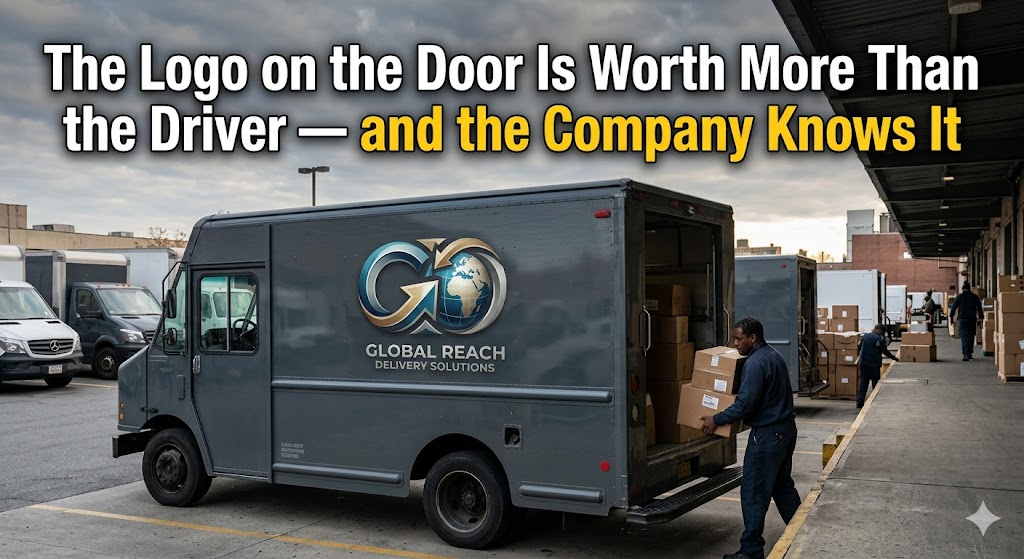
The vehicle that hit you had a name painted on the side. A delivery van, a box truck, a work pickup with a company logo and a phone number — driven by someone on the clock, running a route or rushing to the next job. The crash was bad. But here is what most people never realize in the chaos of the moment: that logo is the most valuable thing at the scene.
Because behind the driver stands a company — with assets, with a commercial insurance policy many times larger than any personal auto policy, and with a legal team whose entire job, starting today, is to make sure that company never has to pay you a dime.
Your Real Opponent Is the Company Behind the Vehicle — and Its First Move Is to Cut the Driver Loose
In an ordinary car wreck, you’re up against one driver’s insurer. In a commercial vehicle case, you’re up against a corporation, and corporations fight differently. Their risk-management apparatus activates fast, and its opening strategy is almost always the same: put distance between the company and the driver who hit you.
You’ll hear the arguments. He wasn’t really on the clock. She was on a personal errand, off her route. He’s an independent contractor, not our employee — talk to him, not us. Each of these is aimed at one goal: severing the legal link between the driver and the deep-pocket employer, so the large commercial policy stays closed and you’re left chasing an individual who may carry only the state minimum.
This matters enormously, because Texas law can hold an employer responsible for the negligence of an employee acting in the course and scope of their job — and can hold a company directly liable for its own failures in hiring, training, supervising, or maintaining its fleet. The company’s lawyers know this. That’s why the fight in a commercial vehicle case is so often not whether the driver was negligent, but who they were really working for and whether they were working at all. Win that fight, and the right policy and the right defendant come into view. Lose it, and a strong case collapses to nothing.
What McKay Law Does to Reach the Real Defendant
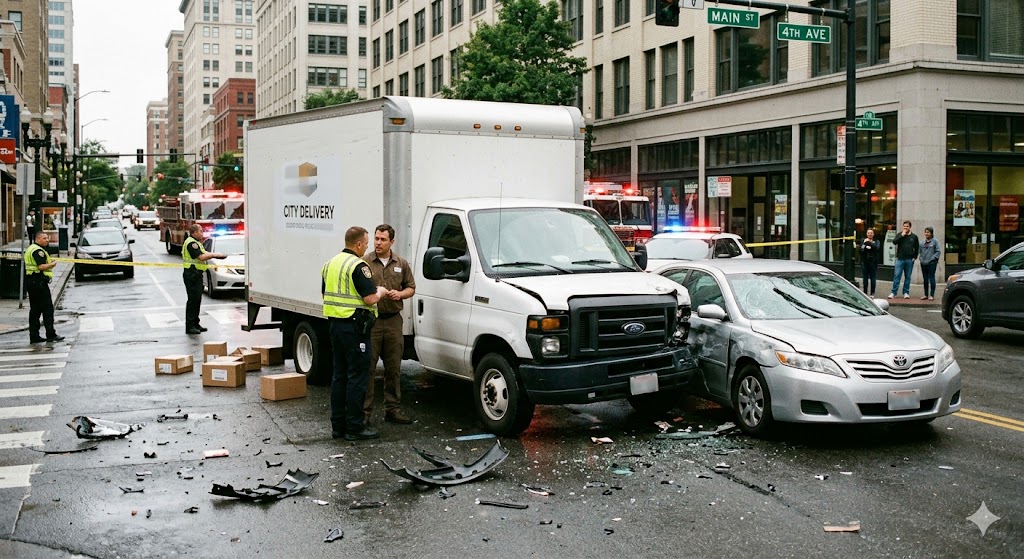
McKay Law handles commercial vehicle accident cases across Texas, and our work begins with the question the company hopes you never ask: who is actually responsible? We identify every potentially liable party — the driver, the employer, the vehicle’s owner, a staffing company, a contractor, a maintenance provider — and every insurance policy that may apply.
To do that, our “Texas Tough” team moves quickly to lock down the proof that establishes the employment relationship and the company’s role, before records can quietly disappear. We send preservation demands, pull the corporate and regulatory paper trail, and bring in the experts who can reconstruct what happened and tie it back to the company’s choices. Our founder, Lindsey McKay, is a member of the Academy of Truck Accident Attorneys and has recovered millions for injured Texans, including a $6,000,000 wrongful-death verdict in a commercial-truck case. We work on contingency — no fee unless we win — and handle your property-damage claim at no charge. See our verdicts and settlements for what that looks like in practice.
Key Takeaways
- The company — not just the driver — is often the real defendant. Texas law lets you hold an employer liable for an employee’s on-the-job negligence, and for its own negligent hiring, training, or maintenance.
- Expect the “independent contractor” and “not on the clock” defenses. They exist to keep the large commercial policy closed; overcoming them is the heart of the case.
- Commercial policies are far larger than personal auto policies. Many Texas commercial carriers must carry $500,000 to $1,000,000+ in coverage — but bigger policies mean more aggressive defense.
- Commercial vehicle ≠ only 18-wheelers. Delivery vans, box trucks, buses, dump trucks, and logo’d work trucks all count.
- The evidence is corporate and it disappears. Telematics, GPS, dispatch logs, driver files, and maintenance records must be preserved fast.
- Government-owned vehicles follow different rules — with much shorter deadlines to give formal notice. Don’t wait.
- The general deadline is two years, but acting early is what protects the evidence and the claim.
The Evidence Chain: Proving the Company Is on the Hook
The short answer: a commercial vehicle case is won by proving two things — that the driver was negligent, and that the company is legally responsible for it. The second half lives in records the company controls, and those records are the first to vanish. Here’s the chain, in the order it matters.
1. Identity of the vehicle and the company. The logo, the license plate, the USDOT or TxDMV number on the door, and the registration establish who owns and operates the vehicle. For interstate carriers, you can pull a company’s safety record, crash history, and operating authority through the FMCSA SAFER Company Snapshot. For Texas intrastate carriers, registration and insurance are filed with the TxDMV Motor Carrier Division.
2. The employment / agency relationship. Pay records, the driver’s schedule, the dispatch assignment, the route, and the company’s own policies show whether the driver was an employee acting in the course and scope of the job — the link the defense will try hardest to break.
3. Telematics, GPS, and dispatch data. Modern fleets track their vehicles constantly. GPS shows where the vehicle was and how fast it was going; dispatch logs show what the driver was told to do and when. This data can confirm the driver was working — and overworked. It is also routinely overwritten unless preserved.
4. The driver qualification file and safety record. Hiring records, training, prior violations, drug-and-alcohol testing, and the company’s compliance with federal hours-of-service rules (for regulated carriers) can establish negligent hiring or supervision against the company directly.
5. Maintenance and inspection records. A company that skipped brake service or ignored a defect can be liable for the resulting crash. These records sit in the company’s files until a legal demand forces them out.
6. The crash report and scene evidence. The Texas Peace Officer’s Crash Report (CR-3), available through TxDOT’s Crash Reports and Records system, plus scene photos, skid marks, vehicle damage, and any dashcam or surveillance footage, anchor how the wreck happened.
7. The medical record and your losses. As in any injury case, prompt and consistent treatment documents the harm, and proof of lost income and life impact builds the full value of the claim — including pain, suffering, and diminished earning capacity.
The theme runs through every link: the proof that connects the crash to the company is held by the company, it degrades fast, and the side sitting on it is the one you’re fighting. Securing it early is most of the work.
Where These Crashes Happen: East Texas and the DFW Metroplex
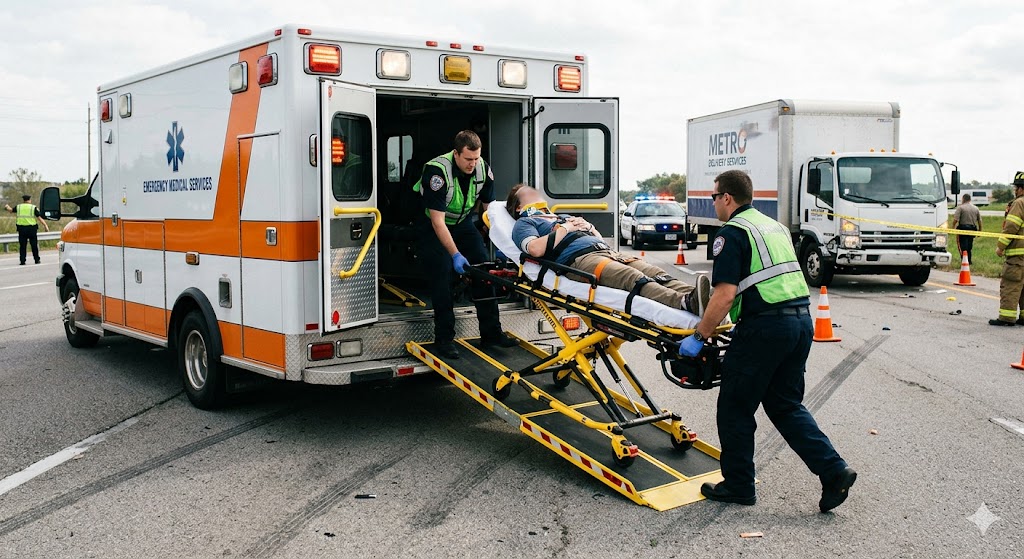
Commercial vehicles are everywhere on Texas roads, and the regional economy shapes the risk.
In East Texas, the commercial traffic skews toward oilfield and energy service trucks, logging and timber haulers, agricultural and construction vehicles, and the freight moving along I-20, US-59, US-271, and US-69. Heavy work vehicles on rural two-lane roads, often driven on long shifts, are a recurring danger. McKay Law’s roots are here, with offices in Sulphur Springs and Tyler serving Hopkins, Hunt, Smith, Gregg, and Rusk counties and the surrounding communities. Explore our East Texas practice or our Tyler office.
In the DFW Metroplex, the explosion of warehousing, distribution, and last-mile delivery has filled the roads with box trucks, sprinter vans, and fleet vehicles — alongside city buses, municipal trucks, and construction fleets — all funneling through I-635 (LBJ), I-35E, I-30, and the Dallas North Tollway. Delivery-vehicle and fleet crashes have climbed with the volume. From our Dallas office, McKay Law represents injured people across Dallas, Collin, Denton, Rockwall, and Tarrant counties; see our Dallas practice.
Whether it’s an energy service truck on an East Texas farm-to-market road or a delivery van in suburban Dallas, the legal challenge is the same: identifying the company behind the vehicle and proving it’s responsible.
Frequently Asked Questions
What counts as a “commercial vehicle”? Far more than 18-wheelers. Delivery vans and box trucks, buses and shuttles, dump and cement trucks, garbage trucks, utility and service vehicles, and company-owned work trucks are all commercial vehicles. What matters legally is that the vehicle was being used for business, which opens the door to corporate liability and commercial insurance.
Who can I hold responsible besides the driver? Potentially several parties: the driver’s employer, the company that owns the vehicle, a staffing agency, a contractor or subcontractor, a maintenance provider, a cargo loader, or a parts manufacturer. Each may carry its own insurance, which can be decisive in a serious-injury case.
The company says the driver was an “independent contractor.” Does that end my claim? No — that label doesn’t automatically settle the question. Courts look at the actual relationship: who controlled the work, the schedule, the route, and the vehicle. Companies use the contractor label to dodge liability, but the real facts often tell a different story, which is exactly what a thorough investigation uncovers.
How much insurance do commercial vehicles carry? Usually far more than a personal policy. Depending on the vehicle and operation, Texas and federal rules can require commercial carriers to maintain $500,000 to $1,000,000 or more in coverage — but larger policies are guarded by more aggressive defense teams.
What if a city, county, or other government vehicle hit me? Different rules apply. Claims against governmental entities in Texas fall under the Texas Tort Claims Act, which sharply limits damages and imposes much shorter deadlines to give formal written notice — sometimes just months, and some cities require even faster notice by ordinance. If a government vehicle was involved, talk to an attorney immediately so a deadline doesn’t quietly bar your claim.
How long do I have to file? Most claims carry a two-year deadline under Texas Civil Practice and Remedies Code § 16.003 — but government-entity notice deadlines are far shorter, and corporate evidence fades fast, so the time to act is now.
What does it cost to hire McKay Law? Nothing up front. We work on contingency — no fee unless we win — and handle property damage at no charge. Contact us for a free consultation, day or night.
About the Author — Lindsey McKay, Founder & President, McKay Law, PLLC
Lindsey McKay is a Texas trial attorney and the founder of McKay Law, PLLC, a personal injury firm she established in 2017 to represent injured people and families against the companies and insurers responsible for their harm.
Raised and educated in Dallas, Texas, Lindsey earned a Bachelor of Science in Economics, with a minor in Spanish, from the University of Colorado, Boulder, completing her degree in three years. She was admitted to the State Bar of Texas in 2008 and has spent nearly two decades in personal injury and commercial litigation — the precise mix of skills commercial vehicle cases demand, where corporate defendants and complex insurance structures are the norm.
Her credentials reflect her “Texas Tough” reputation: Lindsey is a member of the Academy of Truck Accident Attorneys, the Million Dollar Advocates Forum, and the Multi-Million Dollar Advocates Forum — distinctions reserved for attorneys with seven- and eight-figure results — and has been ranked among the Best Car Accident Lawyers by Expertise.com. She has recovered millions for clients, including a $6,000,000 commercial-truck wrongful-death verdict, and McKay Law holds 300-plus five-star Google reviews. She is a member of the State Bar of Texas, the American Bar Association, the Dallas Bar Association, the Dallas Trial Lawyers Association, and the Texas Trial Lawyers Association.
With offices in Sulphur Springs, Dallas, and Tyler, McKay Law serves injured people across East Texas and the Dallas–Fort Worth Metroplex, with a Rapid Response Investigation Team available 24/7. Remember: not every lawyer is an advocate — but every lawyer should be.
📞 Free consultation, 24/7. No fees unless we win. Call (903) 465-8733 — or (903) 226-4232 para servicio en español.
This article is provided for general educational purposes and does not constitute legal advice or create an attorney-client relationship. Every case is different; deadlines for claims against governmental entities are especially strict. For guidance on your specific situation, contact a licensed Texas attorney promptly.
Related Pages & Resources
From McKay Law:
- Texas Commercial Vehicle Accident Lawyer
- Texas Truck Accident Lawyer
- Personal Injury Attorney
- Verdicts & Settlements
- East Texas Practice
- Dallas Practice
- Client Testimonials
- Contact / Free Consultation
Official government resources: