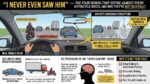
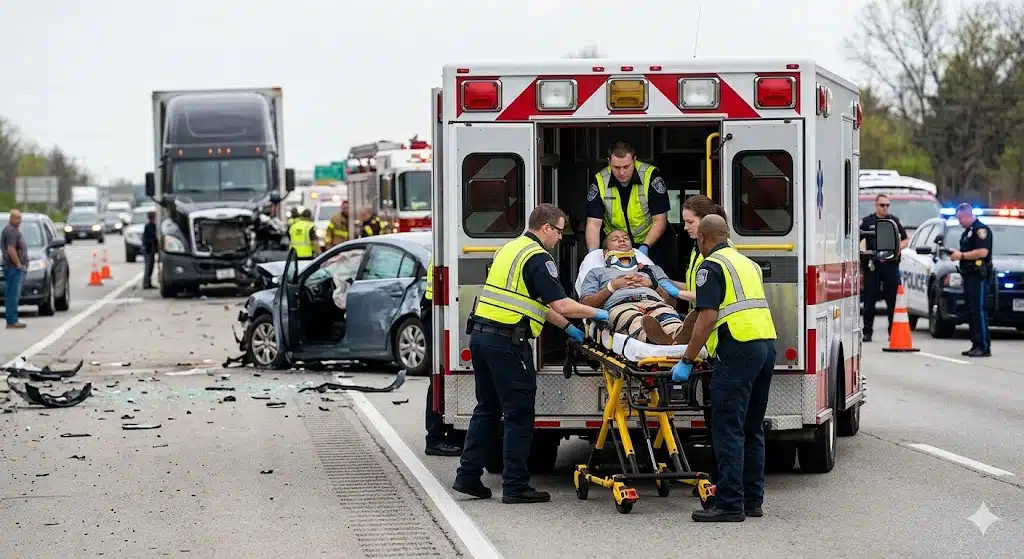
The brake lights ahead of you glow red on I-20 outside Tyler. You slow. The 80,000-pound rig behind you does not. In the time it takes to glance at your mirror, the cab fills your back window, and the world becomes glass, metal, and a sound you will never forget. When the dust settles on the shoulder, you are alive — shaken, hurt, disoriented — and you assume the hard part is over.
It is not. The hard part started the second that truck’s wheels stopped turning. Because somewhere, a phone is already ringing.
Your Real Opponent Isn’t the Driver — It’s the Carrier’s Rapid Response Defense Team
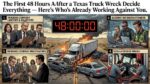
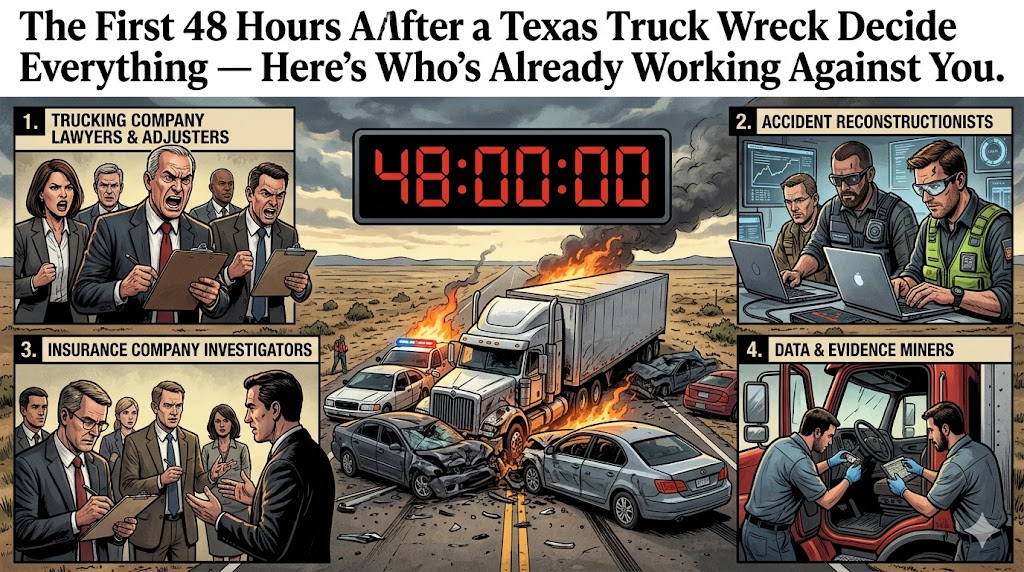
The man who hit you may be apologetic. He may even be in tears. But within hours — sometimes within minutes — the trucking company’s own rapid-response investigators are en route to the scene. This is not a coincidence and it is not customer service. Major motor carriers and their insurers retain dedicated accident teams precisely so they can reach the wreckage before you’ve left the emergency room.
Their mission is the opposite of yours. They photograph the scene to build their version of events. They interview the driver before he can say anything that hurts the company. And critically, they take control of the truck — the single most important piece of evidence in your entire case — and quietly start the clock on how long that evidence survives.
That truck carries an electronic logging device (ELD) and an engine control module, often called the “black box.” Together they record speed, braking, throttle, hours the driver had been awake, and whether he hit the brakes at all before impact. The carrier knows this. And in Texas, absent a legal demand to preserve it, that data can be overwritten, the truck can be repaired or scrapped, and the logbooks can vanish into a filing system you will never see. By the time most injured people think to call a lawyer, the most damning proof against the trucking company may already be gone.
What McKay Law Does Differently — and Faster
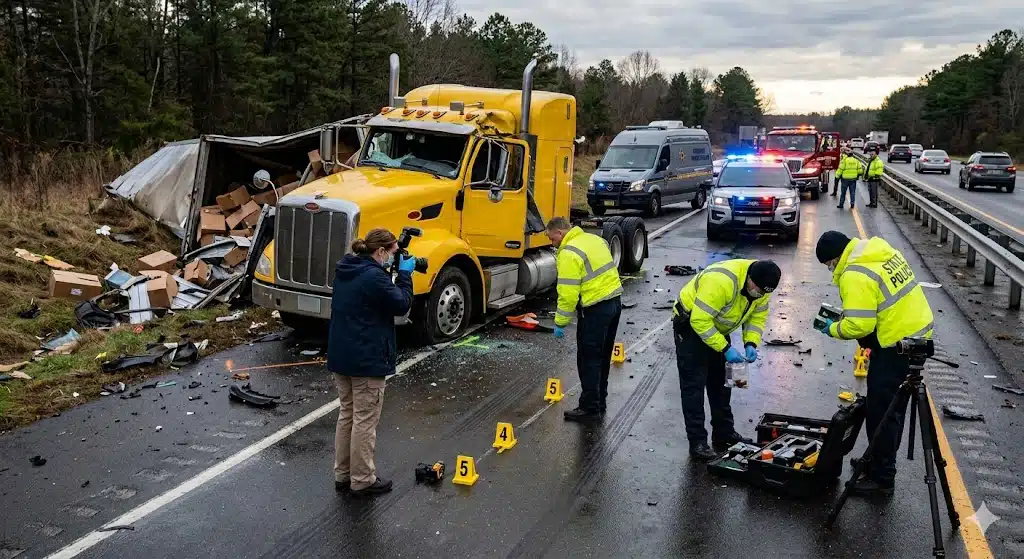
McKay Law exists for exactly this moment. We are a Texas personal injury firm built around commercial vehicle and catastrophic-injury cases, and we run our own Rapid Response Investigation Team for one reason: to get to the evidence before it disappears. (See our Texas truck accident practice for more on how we handle these claims.)
When you call us, we move the same day. We send legal preservation (“spoliation”) letters that legally obligate the carrier to keep the truck, the ELD data, the driver’s logs, the dashcam footage, and the maintenance records intact. We dispatch investigators to document the scene, the skid marks, and the vehicles while they still exist. We line up accident-reconstruction and medical experts early, not as an afterthought. Our founder, Lindsey McKay, has spent nearly two decades doing this work — including a $6,000,000 wrongful-death recovery in a single truck-accident case (see our verdicts and settlements) — and the entire firm operates on one principle our clients hear from day one: we fight for people, never for insurance companies or big business. And we work on contingency, which means no fee unless we win.
Key Takeaways
- The clock starts at impact. Black-box (ELD) and engine-control data can be legally overwritten or lost within days unless a preservation letter is sent.
- The trucking company’s investigators work for the company, not for you — and they often reach the scene before you’ve been discharged from the hospital.
- Evidence wins truck cases. ELD logs, driver hours-of-service records, maintenance files, and dashcam footage are what separate a small settlement from a full recovery.
- Texas has a deadline. The statute of limitations on most personal injury claims is generally two years from the date of the crash — but waiting two years to act will cost you the evidence long before it costs you the case.
- Do not give a recorded statement to the trucking company’s insurer before speaking with your own attorney.
- A truck case is not a car-accident case. Multiple parties — driver, carrier, broker, cargo loader, maintenance contractor — can share liability, and each carries its own insurance policy.
The Forensic Evidence Chain: What Actually Wins a Truck Accident Case
The short answer: truck cases are won or lost on a chain of physical and digital evidence that begins degrading the moment the crash ends. Preserve the chain, and you have leverage. Lose a link, and the carrier’s lawyers will exploit the gap. Here is that chain, in the order it matters.
1. The Electronic Logging Device (ELD) and Engine Control Module. Federal regulations require most commercial trucks to run ELDs that track driving hours, and the engine “black box” captures speed, braking, and throttle in the seconds before impact. This is the closest thing to an eyewitness who cannot lie. It is also the first thing to disappear if no one demands it be preserved. (The FMCSA ELD fact sheet explains what these devices record and who must use them.)
2. Hours-of-Service Logs. Federal Motor Carrier Safety Administration (FMCSA) hours-of-service rules limit how long a driver can legally be behind the wheel. Fatigue is one of the leading causes of serious truck wrecks. When logs show a driver pushed past those limits — or when the company pressured him to — the case shifts from “accident” to “preventable.”
3. The Driver’s File and Carrier’s Safety Record. Prior violations, failed drug tests, inadequate training, and a history of speeding or logbook violations can establish that the company put an unsafe driver on the road. Negligent hiring and negligent supervision are claims aimed not at the driver, but at the corporation that employed him.
4. Maintenance and Inspection Records. A blown tire, failed brakes, or a skipped inspection can make the carrier — or a third-party maintenance contractor — directly liable. These records also tend to “go missing” without a preservation demand.
5. Physical Scene Evidence. Skid marks, debris fields, vehicle resting positions, and the damage patterns on both vehicles allow an accident reconstructionist to calculate speed and force. Roads get cleaned and vehicles get towed and crushed, so this evidence has the shortest shelf life of all.
6. Dashcam and Surveillance Footage. Many fleets run forward- and driver-facing cameras. Nearby businesses and traffic cameras may have caught the wreck too. Footage is often overwritten on a rolling cycle measured in days.
7. The Medical Record. Finally, your injuries must be documented from the start. Gaps in treatment are the single most common argument insurers use to minimize what they pay. Prompt, consistent medical care is not just good for your health — it is evidence.
One more record matters early: the official crash report. In Texas, you can obtain the Texas Peace Officer’s Crash Report (CR-3) through TxDOT’s Crash Reports and Records system — and we help our clients pull it as part of building the file.
The takeaway is simple. Each link in this chain is fragile, and the party holding most of it is the one you’re up against. The job of your attorney is to lock down the entire chain before the other side can decide which links survive.
Where These Wrecks Happen: East Texas and the DFW Metroplex
Truck traffic in Northeast Texas and the Dallas–Fort Worth corridor is relentless, and the geography shapes the danger.
In East Texas, the freight runs through on I-20 and I-30, the long east–west arteries connecting the Metroplex to Shreveport, with US-271 and US-69 feeding the smaller cities. We see catastrophic wrecks around Sulphur Springs, Tyler, Longview, Mount Pleasant, Texarkana, Paris, and across Hopkins, Hunt, Titus, and Smith counties. These are high-speed rural and semi-rural stretches where a fatigued driver has little margin for error and emergency response can be miles away. McKay Law’s roots are here — our team works the 903 every day and knows the courthouses, the highways, and the hospitals that injured families end up in. Our East Texas truck accident team is built around exactly these cases.
In the DFW Metroplex, the problem is volume and congestion. The interchange of I-635 (LBJ), I-35E, I-30, and the Dallas North Tollway funnels enormous commercial traffic through dense, fast-stopping lanes where rear-end and underride collisions turn deadly. Lindsey McKay was raised and educated in Dallas, is a member of the Dallas Bar Association and the Dallas Trial Lawyers Association, and the firm represents injured people throughout Dallas, Collin, Denton, Rockwall, and Tarrant counties. Learn more about our Dallas car and truck accident practice or our work in Forney.
Whether your wreck happened on a quiet East Texas highway or in the middle of LBJ at rush hour, the evidence problem is identical — and so is the urgency.
Frequently Asked Questions
How long do I have to file a truck accident claim in Texas? Most personal injury claims in Texas carry a two-year statute of limitations from the date of the crash under Texas Civil Practice and Remedies Code § 16.003. But the practical deadline is much sooner: the evidence that proves your case can be lost within days, so the time to act is now, not in 23 months.
The trucking company’s insurer called me. Should I give a statement? No — not before you’ve spoken with your own attorney. Recorded statements are taken to find words they can use to reduce or deny your claim. You are not required to give one, and you should not.
Who can be held responsible besides the driver? Often several parties: the trucking company, a separate cargo loader, a freight broker, a maintenance contractor, or even a parts manufacturer. Each may carry its own insurance, which can matter enormously in a serious-injury or wrongful-death case.
What is a spoliation letter and why does it matter so much? It is a formal legal notice that requires the carrier to preserve specific evidence — the truck, the ELD data, the logs, the footage. Without it, that evidence can lawfully be destroyed in the ordinary course of business. Sending it fast is one of the most important things a truck-accident lawyer does.
What does it cost to hire McKay Law? Nothing up front. We handle truck and auto cases on contingency — there is no fee unless we win, and we handle property-damage claims at no charge to our injured clients. Contact us for a free consultation, or read what our clients say in our testimonials.
What if a loved one was killed in a truck crash? Texas law allows certain family members to bring a wrongful-death claim. These are among the most serious cases we handle; Lindsey McKay has recovered a $6,000,000 verdict in a truck-accident wrongful-death matter.
About the Author — Lindsey McKay, Founder & President, McKay Law, PLLC
Lindsey McKay is a Texas trial attorney and the founder of McKay Law, PLLC, a personal injury firm she established in 2017 to focus exclusively on representing injured people — car and truck wreck victims, families in wrongful-death cases, and survivors of catastrophic injury.
Raised and educated in Dallas, Texas, Lindsey earned a Bachelor of Science in Economics, with a minor in Spanish, from the University of Colorado, Boulder, completing her degree in three years. She was admitted to the State Bar of Texas in 2008 and has spent nearly two decades — roughly 17 years and counting — in personal injury and commercial litigation.
Her record reflects her “Texas Tough” approach: a $6,000,000 wrongful-death recovery in a truck-accident case, millions recovered for injured clients, and a firm with 300-plus five-star Google reviews built on weekly client communication and relentless advocacy. Lindsey is a member of the State Bar of Texas, the American Bar Association, the Dallas Bar Association, the Dallas Trial Lawyers Association, and the Texas Trial Lawyers Association.
McKay Law serves injured people across East Texas and the Dallas–Fort Worth Metroplex, with a Rapid Response Investigation Team available 24/7. Remember: not every lawyer is an advocate — but every lawyer should be.
? Free consultation, 24/7. No fees unless we win. Call (903) 465-8733.
This article is provided for general educational purposes and does not constitute legal advice or create an attorney-client relationship. Every case is different; for guidance on your specific situation, contact a licensed Texas attorney.
Related Pages & Resources
From McKay Law:
- Texas Truck Accident Lawyer
- East Texas Truck Accident Lawyer
- Dallas Car & Truck Accident Lawyer
- Personal Injury Attorney
- Verdicts & Settlements
- Client Testimonials
- Contact / Free Consultation
Official government resources: