Texas Comparative Fault Rules Explained: What Happens When You’re Partly to Blame?
One of the first questions injury victims ask after an accident is: “What if I was partly at fault?”
It’s a fair and important question — and the answer can make or break your case.
In Texas, the law recognizes that accidents are rarely 100% one person’s fault. Two drivers might both be doing something wrong when a crash happens. A worker might have ignored a safety rule on a job site that was also poorly managed. A shopper might have been distracted when they slipped on a wet floor the store failed to mark.
Texas has a legal framework specifically designed to handle these situations. It’s called comparative fault — sometimes referred to as proportionate responsibility or comparative negligence — and understanding how it works is essential for any injury victim in East Texas.
At McKay Law, we help clients throughout East Texas understand their rights under Texas law and fight back when insurance companies try to use shared fault to minimize or eliminate their recovery. This guide breaks down everything you need to know — in plain language.
What Is Comparative Fault?
Comparative fault is a legal rule that determines how compensation is divided when more than one party shares responsibility for an accident.
Instead of an all-or-nothing approach — where either you win everything or you get nothing — comparative fault allows a jury (or an insurance adjuster, or a judge) to assign a percentage of responsibility to each party involved. Your compensation is then adjusted based on your share of the blame.
It sounds simple in concept. In practice, the percentages matter enormously — and the fight over who gets how much blame is often where personal injury cases are won or lost.
The Two Basic Systems: A Quick History Lesson
To understand why Texas’s system works the way it does, it helps to know there are two main approaches to comparative fault used across the United States:
Pure Comparative Fault — Used in some states, this system allows a plaintiff to recover damages no matter how much they were at fault, even if they were 99% responsible. Their recovery is simply reduced by their percentage of fault. Texas does not use this system.
Modified Comparative Fault — This is what Texas uses. Recovery is allowed, but only up to a certain fault threshold. Once you cross that threshold, you recover nothing. Texas draws that line at 51%.
Texas’s Rule: The Modified Comparative Fault System (The “51% Rule”)
Texas follows the modified comparative fault system, codified in Chapter 33 of the Texas Civil Practice and Remedies Code, sometimes called the Proportionate Responsibility chapter.
Here is the core rule in plain language:
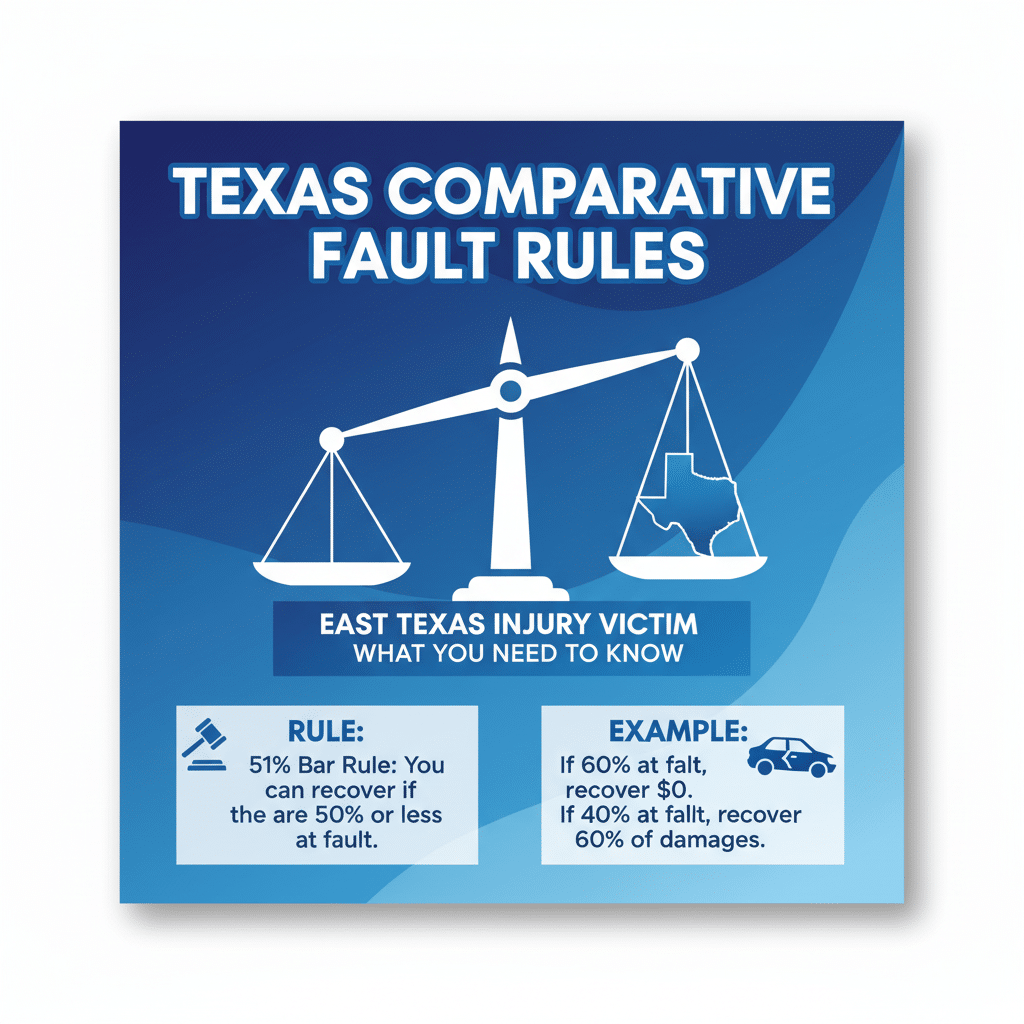
You can recover compensation for your injuries as long as you are found to be 50% or less at fault. If you are found to be 51% or more at fault, you recover nothing. If you do recover, your compensation is reduced by your percentage of fault.
Let’s break that down with real examples.
How the 51% Rule Works: Real-World Examples
Example 1: The Clear Case
Maria is rear-ended at a red light in Tyler by a driver who was texting. The jury finds Maria was 0% at fault and the other driver was 100% at fault. Maria receives 100% of her awarded damages. Straightforward.
Example 2: Shared Fault — You Still Recover
James is in a car accident on a Longview highway. The other driver ran a stop sign — but James was also speeding at the time. The jury finds:
- Other driver: 70% at fault
- James: 30% at fault
The jury determines James’s total damages are $100,000.
Because James was 30% at fault, his recovery is reduced by 30%.
James recovers $70,000.
James was partially responsible — but he still recovers a significant amount because his fault was under 51%.
Example 3: Right at the Line — The Stakes of Every Percentage Point
Same accident. But this time the jury finds:
- Other driver: 51% at fault
- James: 49% at fault
Total damages: $100,000. James recovers $51,000 (reduced by his 49% share).
Now imagine the jury shifts just two percentage points — finding James 51% at fault. James recovers zero dollars. Nothing.
That two-percentage-point difference is the difference between a $51,000 recovery and walking away with nothing. This is why the fight over fault percentages is so critical — and why having an experienced East Texas attorney in your corner matters so much.
Example 4: Multiple Parties
Sarah slips and falls at a Marshall retail store. The store failed to put up a wet floor sign, but Sarah was also looking at her phone when she fell. There was also a third party — a cleaning contractor — who created the hazard. The jury assigns:
- Store: 50% at fault
- Cleaning contractor: 30% at fault
- Sarah: 20% at fault
Total damages: $200,000. Sarah’s recovery is reduced by her 20%:
Sarah recovers $160,000 — split proportionately between the store and the contractor based on their shares of fault.
The 5 Basic Rules of Texas Comparative Fault — Simplified
Here are the five most important things to remember about how Texas comparative fault works:
Rule 1: Your Fault Percentage Reduces Your Recovery Dollar-for-Dollar
If you are found 10% at fault, you lose 10% of your damages. If you are found 40% at fault, you lose 40%. The math is direct and proportional.
What this means for you: Even a small increase in your assigned fault percentage can cost you thousands of dollars. Every percentage point matters.
Rule 2: The 51% Threshold Is the Point of No Return
If you are found 51% or more responsible for the accident, you receive nothing under Texas law — regardless of how seriously you were injured or how much the other party contributed to the accident.
What this means for you: Insurance companies and defense attorneys know this rule. Their strategy is often to push your fault percentage above 50% so they can eliminate your recovery entirely. Never accept a fault determination without legal guidance.
Rule 3: The Jury Decides Fault Percentages — But So Do Insurance Adjusters
In cases that go to trial, a jury hears the evidence and assigns fault percentages to each party. But the reality is that the vast majority of personal injury cases settle before trial — meaning an insurance adjuster is effectively making the initial fault determination when they calculate a settlement offer.
What this means for you: Insurance adjusters are not neutral. They work for the insurance company, whose goal is to minimize payouts. Their fault calculations often inflate the victim’s percentage. An attorney who understands comparative fault can challenge those determinations and negotiate toward a fair number.
Rule 4: All Responsible Parties — Including Non-Parties — Can Be Assigned Fault
Under Texas law, the jury can assign fault not just to the parties in the lawsuit, but also to responsible third parties who were identified during the case. This is called the responsible third party designation under Chapter 33.
This can work for or against you. On one hand, a defendant might try to point the finger at someone else — including the deceased, an absent party, or a settling defendant — to reduce their own share. On the other hand, your attorney can use this rule to bring additional responsible parties into the fault picture and increase the total compensation available.
What this means for you: The full landscape of who contributed to your accident must be carefully investigated. McKay Law works to identify every responsible party and structure your case to maximize recovery.
Rule 5: Some Claims Are Not Subject to Comparative Fault
Not every Texas injury claim is governed by Chapter 33’s proportionate responsibility rules. There are important exceptions, including certain product liability claims under specific circumstances, and workers’ compensation claims operate under an entirely separate framework.
What this means for you: The type of claim you have matters. An experienced attorney will evaluate which legal theories apply to your case and which fault rules govern each one.
How Insurance Companies Use Comparative Fault Against You
Understanding comparative fault isn’t just academic — it directly affects how insurance companies treat your claim.
Here’s what to watch for:
Recorded statements. Insurance adjusters often call injury victims shortly after an accident and ask questions designed to get you to admit partial fault. “Were you watching the road?” “Were you in a hurry?” “Did you see the warning sign?” Statements you make — even innocent ones — can be used to assign you a higher fault percentage.
Accident report manipulation. Insurance companies scrutinize police reports, witness statements, and photographs looking for anything that suggests you contributed to the accident.
Low-ball offers justified by “shared fault.” You may receive a settlement offer that has already been reduced based on the adjuster’s internal fault assessment — an assessment you’ve never been shown and may not even know about.
Waiting you out. The longer a claim drags on, the more desperate some victims become. Insurance companies sometimes delay specifically to pressure victims into accepting reduced offers that account for inflated fault percentages.
The bottom line: Insurance companies use comparative fault as a tool to pay you less. McKay Law uses it as a framework for fighting back — documenting the true facts, gathering expert testimony, and pushing fault numbers where they actually belong.
What Factors Determine Fault Percentage?
When a jury or adjuster evaluates fault, they consider a wide range of evidence, including:
Physical evidence — skid marks, point of impact, vehicle damage patterns, road conditions, traffic signals, signage, maintenance records.
Witness testimony — what did bystanders see? What did the parties themselves say at the scene?
Expert analysis — accident reconstructionists can calculate speeds, sight lines, reaction times, and the sequence of events with scientific precision.
Photographs and video — dashcam footage, surveillance cameras, cell phone photos taken at the scene.
Medical records — the nature and timing of injuries can help establish how an accident actually occurred.
Prior knowledge — did a property owner know about a dangerous condition? Did a trucking company know a driver had safety violations?
Violation of law — speeding, running a red light, driving under the influence, violating safety regulations. A legal violation is strong evidence of fault, though not automatic proof.
The strength of the evidence on each side is what drives the final fault percentage. This is why thorough investigation — beginning immediately after the accident — is so critical.
East Texas Comparative Fault Cases: Industries and Scenarios We Handle
Comparative fault issues arise in virtually every type of personal injury and wrongful death case. At McKay Law, we regularly handle comparative fault disputes in:
Auto and Truck Accidents — Fault disputes over speeding, following distance, lane changes, failure to yield, and distracted driving are among the most common in East Texas.
Oilfield and Industrial Accidents — East Texas energy and manufacturing industries generate serious workplace injury cases where employers often argue the worker’s own actions caused or contributed to the accident.
Slip and Fall Cases — Property owners routinely argue that an injured person should have seen the hazard and avoided it. We fight back with evidence of inadequate lighting, missing signage, and known dangerous conditions.
Wrongful Death Cases — When a family member’s death is at issue, fault percentage fights can be especially aggressive. Defendants may try to blame the deceased person, who cannot speak for themselves. We speak for them.
Product Liability — Manufacturers sometimes argue that a product user misused the product or ignored warnings. We analyze whether alleged “misuse” was actually foreseeable and ordinary.
Premises Liability — Beyond slip and fall, these cases include swimming pool accidents, inadequate security cases, and dangerous property conditions throughout East Texas.
Frequently Asked Questions About Texas Comparative Fault
If I was in a car accident and got a ticket, does that mean I’m automatically at fault?
No. A traffic citation is evidence of fault, but it is not conclusive proof. You can still dispute the facts, present contrary evidence, and argue that the other party’s conduct was the primary cause of the accident. A ticket does not automatically end your claim.
What if the insurance company tells me I was 60% at fault?
That is their assessment — not a legal finding. You have the right to dispute it. An attorney can evaluate the evidence, challenge their determination, and negotiate toward a fair fault allocation. Never accept a fault percentage from an insurance company without getting a second opinion from an attorney.
Can comparative fault be raised in a wrongful death case?
Yes. Defendants frequently argue that a deceased victim was partly responsible for the accident that caused their death. The same 51% rule applies. This is one of the most painful aspects of wrongful death litigation, and McKay Law works aggressively to protect the memory and rights of the deceased.
What if I didn’t have my seatbelt on — does that affect my case?
Texas has a specific rule called the seatbelt defense under Transportation Code § 545.413. Evidence of seatbelt non-use can be admitted in civil cases to reduce damages, but only for injuries that the seatbelt would have prevented. It does not eliminate your entire claim.
Does comparative fault apply to medical malpractice cases in Texas?
Yes, proportionate responsibility generally applies in medical malpractice cases, though healthcare liability claims in Texas are governed by additional specific rules under Chapter 74 of the Texas Civil Practice and Remedies Code.
How long do I have to file a personal injury lawsuit in Texas?
The general statute of limitations in Texas is two years from the date of the injury (Texas Civil Practice & Remedies Code § 16.003). Some cases — particularly those involving government entities — have much shorter deadlines. Do not wait to contact an attorney.
What does a comparative fault attorney do that I can’t do myself?
An experienced attorney investigates the accident, gathers and preserves evidence, retains expert witnesses, challenges the opposing party’s fault narrative, and negotiates from a position of knowledge and legal authority. The difference between a 45% fault finding and a 55% fault finding can mean the difference between a substantial recovery and zero. That difference is almost always the result of legal representation.
Why McKay Law Is East Texas’s Comparative Fault Authority
Proportionate responsibility law sounds straightforward on paper. In a real case — with insurance companies, defense attorneys, expert witnesses, and tens or hundreds of thousands of dollars on the line — it is anything but simple.
McKay Law has spent years litigating fault disputes in East Texas courts. We understand:
- How local juries in Smith, Gregg, Harrison, Nacogdoches, and Cherokee Counties evaluate comparative fault evidence
- How to use accident reconstruction, medical testimony, and witness evidence to anchor fault where it belongs
- How to counter the tactics insurance adjusters and defense attorneys use to inflate the victim’s fault percentage
- When to fight — and when a negotiated resolution serves our clients’ best interests
We handle personal injury and wrongful death cases on a contingency fee basis, which means you pay nothing unless we recover for you. There is no financial risk in calling us.
Don’t Let the Insurance Company Write Your Fault Percentage
The single most important thing to understand about Texas comparative fault is this: the percentage of fault assigned to you is not a fact — it is an argument. And arguments can be won.
If you’ve been injured in East Texas and the other side is claiming you share the blame, contact McKay Law before you accept any offer, give any statement, or sign anything.
? Call McKay Law or visit McKayLawtx.com to schedule your free consultation today.
Serving Tyler, Longview, Marshall, Texarkana, Nacogdoches, Henderson, Jacksonville, Lufkin, and all of East Texas.
This article is for general informational purposes only and does not constitute legal advice. Texas law is complex, and every case is different. Contact McKay Law for a confidential evaluation of your specific situation.