If you or a loved one has been involved in a collision with a large commercial truck in East Texas, you are likely facing a whirlwind of emotions and logistical nightmares. The physical pain, the mounting medical bills, and the uncertainty about your job can feel paralyzing. It is natural to wonder about the value of your case. You need to know if you will be able to cover your expenses and secure your family’s future.
While no attorney can give you an exact dollar figure without a thorough investigation, understanding the factors that influence settlement values can provide clarity and peace of mind. Truck accident cases are vastly different from standard car wrecks. They involve complex federal regulations, higher insurance policies, and often, catastrophic injuries.
At McKay Law, we understand the physical, emotional, and financial toll that personal injuries can have on individuals and their families. We are dedicated to providing compassionate support and personalized legal guidance to help you navigate this difficult time. This guide will walk you through the specific elements that determine the worth of a truck accident claim in East Texas.
Understanding Truck Accident Claims in East Texas
East Texas is a hub for commercial transportation. With major corridors like I-20, US-69, US-59, and US-259 crisscrossing the region, we see a high volume of 18-wheelers, logging trucks, and oilfield vehicles sharing the road with passenger cars.
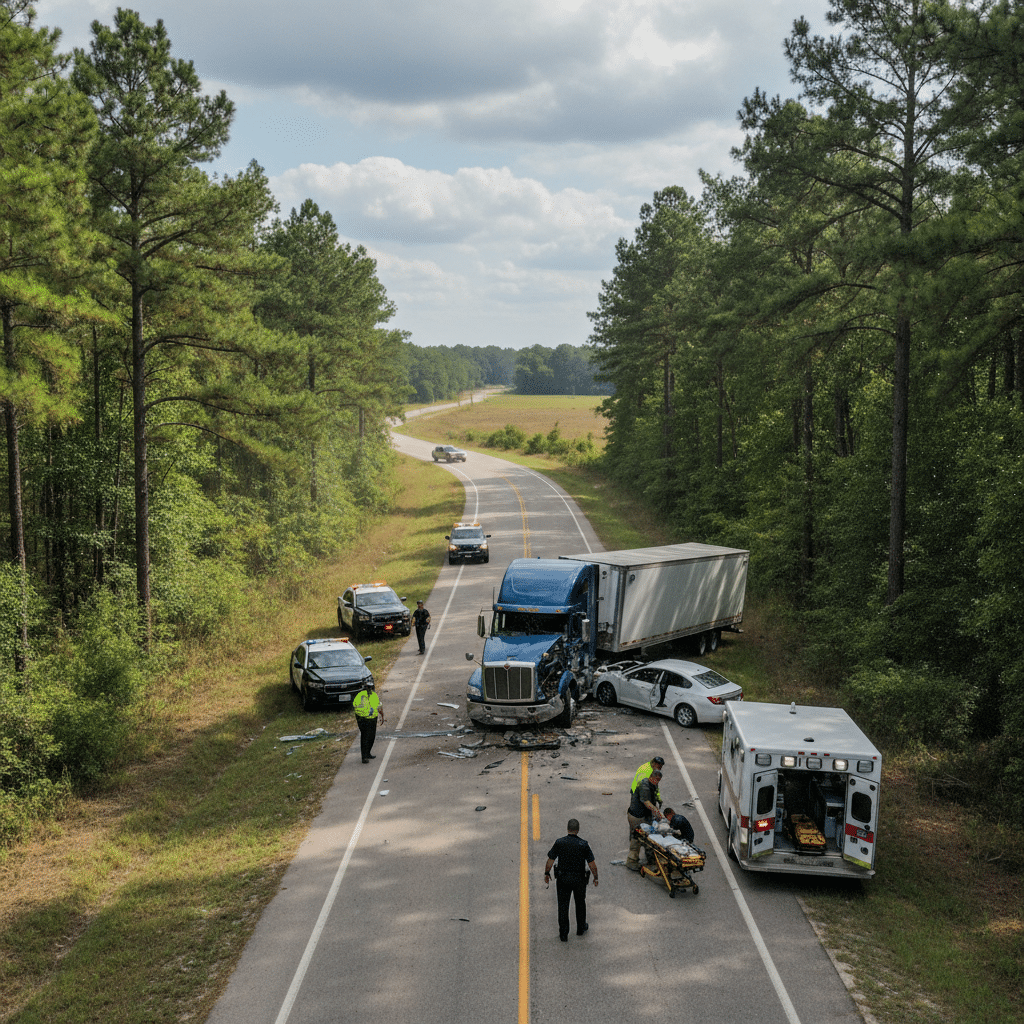
When a passenger vehicle collides with an 80,000-pound tractor-trailer, the results are often devastating. Because the damages are usually severe, the potential value of these cases tends to be higher than typical car accidents. However, trucking companies and their insurers fight aggressively to minimize these payouts. They have teams of lawyers and adjusters whose sole job is to devalue your claim.
To combat this, you need a legal team that understands the nuances of East Texas roadways and the tactics used by commercial carriers. We pride ourselves on a track record of proven success, delivering exceptional results for our clients by building cases that hold negligent parties fully accountable.
Factors Influencing the Value of a Truck Accident Case
The value of your case is generally calculated by adding up your economic losses (financial) and your non-economic losses (human impact), and in some cases, adding punitive damages.
Economic Damages
These are the objective, financial losses you have incurred and will incur in the future. They are the easiest to prove with documentation but require expert analysis to calculate accurately for the long term.
- Medical Expenses: This includes everything from the ambulance ride and emergency room visit to surgeries, rehabilitation, and medication. Crucially, it also includes future medical costs. If you require lifelong care or future surgeries, those costs must be included in the settlement.
- Lost Wages: If your injuries prevented you from working, you are entitled to reimbursement for that lost income.
- Loss of Earning Capacity: In severe cases, you may never be able to return to your previous job or work at all. We work with financial experts to calculate the difference between what you would have earned over your lifetime versus what you can earn now.
- Property Damage: This covers the repair or replacement of your vehicle and any personal items damaged in the crash.
- Out-of-Pocket Expenses: Any other costs related to the accident, such as travel to medical appointments or hiring help for household chores you can no longer perform.
Non-Economic Damages
These damages cover the subjective, human cost of the accident. While money cannot undo the trauma, it is the legal system’s way of acknowledging your suffering. In Texas, there is generally no cap on non-economic damages in truck accident cases (unlike medical malpractice).
- Pain and Suffering: Compensation for the physical pain and discomfort caused by your injuries.
- Mental Anguish: Damages for the emotional distress, anxiety, depression, and PTSD that often follow a traumatic event like a truck crash.
- Physical Impairment and Disfigurement: Compensation for scarring, loss of limb, or permanent disability that alters your quality of life.
- Loss of Consortium: Damages awarded to your spouse or family members for the loss of companionship, affection, and support.
Punitive Damages
In rare cases where the truck driver or trucking company’s actions were not just negligent but “grossly negligent” or malicious, you may be entitled to punitive (exemplary) damages. These are designed to punish the wrongdoer and deter similar conduct.
Examples might include a trucking company knowingly hiring a driver with a history of DWI, or a driver operating under the influence of drugs.
Under Texas Civil Practice and Remedies Code § 41.008, punitive damages are capped. The award generally cannot exceed the greater of:
- $200,000; or
- Two times the amount of economic damages plus an amount equal to any non-economic damages found by the jury (not to exceed $750,000).
Liability and Comparative Negligence in Texas
One of the most critical factors in determining case value is liability—proving who was at fault. Texas follows a “Modified Comparative Negligence” rule, also known as the 51% Bar Rule.
Under Texas Civil Practice & Remedies Code § 33.001, you may not recover damages if your percentage of responsibility is greater than 50%.
Here is how it works in practice:
- 0% Fault: If the truck driver is 100% at fault, you are entitled to 100% of the damages.
- 20% Fault: If a jury finds you suffered $100,000 in damages but were 20% responsible for the accident (perhaps for speeding slightly), your award would be reduced by 20%. You would receive $80,000.
- 51% Fault: If you are found to be 51% or more responsible for the accident, you receive $0.
Trucking company defense lawyers know this rule well. They will look for any evidence—cell phone records, black box data, witness statements—to shift at least 51% of the blame onto you. This is why McKay Law’s Rapid Response Investigation Team is dedicated to providing swift and thorough support. We secure evidence immediately to protect your rights and prevent unfair blame-shifting.
The Role of Insurance Coverage Limits
Even if your damages are calculated at $5 million, the actual recovery may be limited by the trucking company’s insurance policy limits and their assets.
Fortunately, commercial trucks are required by the Federal Motor Carrier Safety Administration (FMCSA) to carry much higher liability insurance than passenger cars. According to 49 CFR § 387.9, the minimum liability limits are:
- $750,000: For standard commercial vehicles over 10,000 lbs carrying non-hazardous freight.
- $1,000,000: For vehicles transporting oil or certain hazardous materials.
- $5,000,000: For vehicles transporting large quantities of hazardous materials or explosives.
Many large trucking fleets carry policies well in excess of these minimums, sometimes reaching into the tens of millions. However, smaller independent operators may only carry the minimum. Identifying all layers of insurance coverage—including the driver, the trucking company, the trailer owner, and potentially the cargo loader—is a vital part of maximizing your compensation.
Common Injuries in East Texas Trucking Accidents
The value of a case is intrinsically linked to the severity of the injury. In East Texas, where trucks often travel at high speeds on two-lane rural highways or congested interstates, the injuries we see are often catastrophic.
- Traumatic Brain Injuries (TBI): Brain injuries can range from concussions to permanent cognitive impairment. These cases often have high values due to the need for lifelong care and the profound impact on the victim’s personality and ability to work.
- Spinal Cord Injuries: Paralysis (paraplegia or quadriplegia) results in massive economic damages for home modifications, 24/7 care, and lost lifetime earnings, alongside significant non-economic damages.
- Amputations: The sheer force of a truck collision can crush limbs, leading to amputation. These injuries carry significant value due to physical impairment and mental anguish.
- Severe Burns: Accidents involving tanker trucks carrying fuel or chemicals can result in fires. Burn injuries are incredibly painful and require extensive, costly surgeries and skin grafts.
Lindsey McKay understands the physical, emotional, and financial toll that personal injuries can have. We approach cases involving these injuries with the utmost sensitivity and determination, ensuring every future medical need is accounted for in the settlement demand.
Why Local Expertise Matters
When asking “what is my case worth,” geography matters. A case tried in Harrison County or Gregg County may have a different potential outcome than a case in Dallas or Austin.
Local factors that influence case value include:
- Jury Demographics: East Texas juries are known for being fair but can be conservative regarding handouts. Your attorney must know how to present evidence in a way that resonates with local values, emphasizing responsibility and accountability.
- Knowledge of Local Industry: Understanding the specific pressures on East Texas drivers—such as the rush to move timber or oilfield equipment—can help uncover negligence.
- Reputation with Local Courts: An attorney who is respected by local judges and defense counsel can often negotiate more effectively.
At McKay Law, we are deeply rooted in this community. We know the roads, we know the courts, and we know how to fight for East Texans.
Conclusion: How to Get an Accurate Valuation of Your Case
There is no online calculator that can accurately tell you what your truck accident case is worth. Every accident involves a unique combination of liability facts, insurance policies, and personal suffering.
However, time is of the essence. In Texas, the Statute of Limitations for personal injury claims is generally two years from the date of the accident (Civil Practice and Remedies Code § 16.003). Waiting too long can result in evidence disappearing and your right to compensation being lost forever.
If you are feeling overwhelmed, you are not alone. Our team is here to shoulder the legal burden so you can focus on healing. McKay Law offers free consultations and operates on a contingency fee basis, meaning clients pay nothing upfront and no legal fees unless the case is won. This approach ensures that everyone has access to quality legal representation without financial risk.
Don’t settle for a quick offer from an insurance company that doesn’t understand the full extent of your pain. Contact us today to discuss your case and learn how we can help you secure the maximum compensation you deserve.