
By Lindsey McKay | McKay Law | April 5, 2025
I’ve sat across from many truck accident victims in our Law firm conference rooms in Sulphur Springs, Tyler, Greenville, and Longview. Some of them came to me weeks after the wreck. Some come to the office months later, after they’d already talked to an adjuster who made the whole accident settlement sound simple — like the insurance company had their best interests at heart, like a quick check was actually a fair one.
It’s never simple. And the check is never fair — not at first.
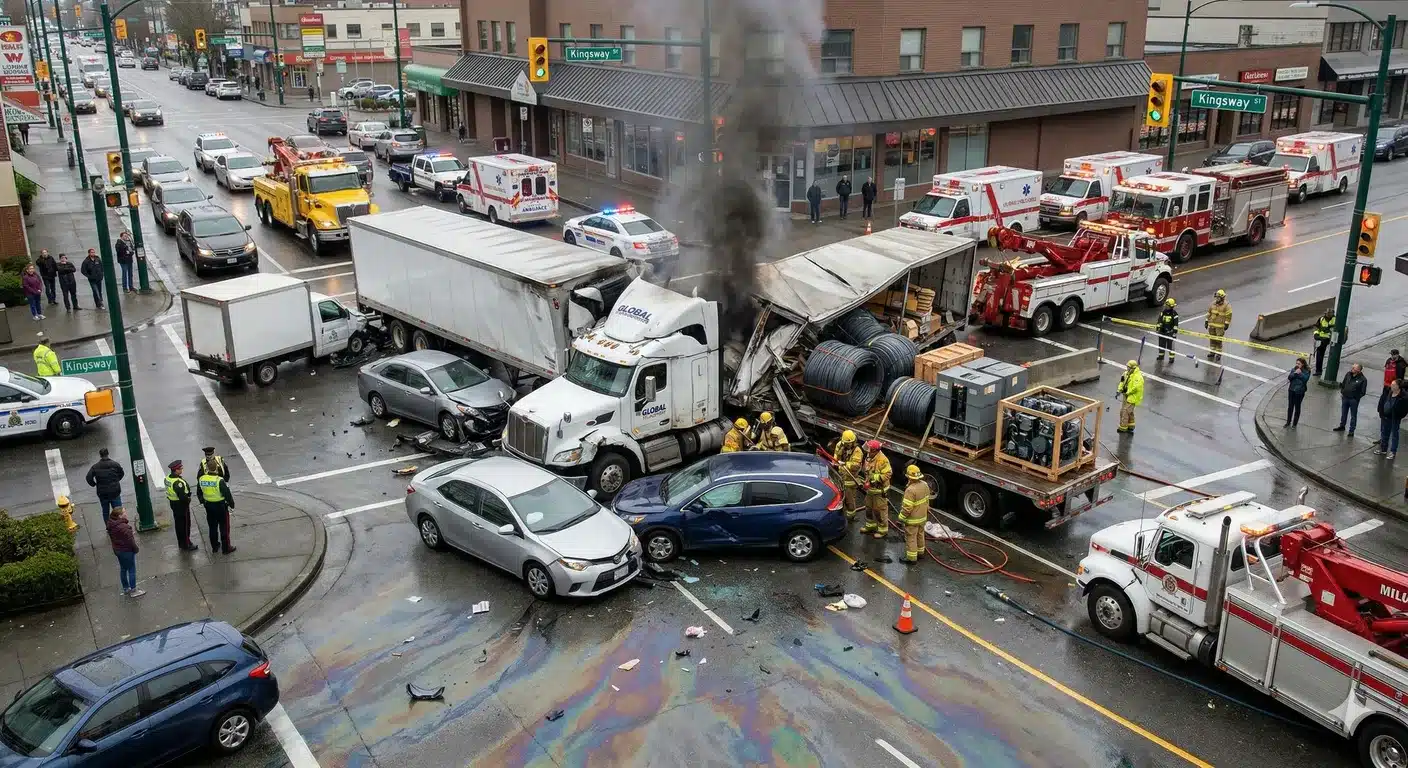
Truck accident cases in East Texas are genuinely different from car accident cases. The injuries in truck accidents are usually worse, the corporate structure behind the negligent defendant is more complicated, and the insurance picture has layers most people never think about. I want to walk you through what actually moves the needle on settlement value in these complicated accident cases, because if you’re dealing with one of these right now, you need to understand what’s really at stake.
The Insurance Picture Is More Complicated Than You Think
When a commercial truck hits you on US-69 or out on I-20, you’re not just dealing with one insurance policy. You’re dealing with a system designed to protect the trucking company — and it works in layers.
Most commercial trucking operations carry a primary liability policy somewhere in the range of $1 million to $5 million. That sounds like a lot of money until you’re looking at a traumatic brain injury, a spinal cord injury, or a wrongful death with a young family behind it. The primary policy runs out fast.
What many people don’t know is that many trucking companies — especially the larger regional and national carriers operating in East Texas — carry excess liability policies on top of that. Sometimes umbrella coverage extends into the tens of millions of dollars. These policies only kick in when the primary limits are exhausted, but they exist, and finding them is part of doing this job right.
This is what lawyers mean when they talk about policy stacking — identifying every layer of coverage that can be accessed, from every insurer involved, and making sure none of it gets left on the table. In a catastrophic injury case, that work can be the difference between a settlement that covers your future medical needs and one that doesn’t.
There’s another piece to this that most people have never heard of: Self-Insured Retention, or SIR. Certain trucking companies structure their insurance plans so that they absorb the first chunk of any loss — say, the first $2 million — before their insurer even gets involved. When that’s the structure, you’re negotiating directly with the company for that portion of the case. That changes the dynamic completely, and you need to know it going in.
Federal Violations Change Everything
The trucking industry doesn’t just answer to Texas law. It answers to the Federal Motor Carrier Safety Administration and to a set of regulations that govern how many hours a driver can operate, what records they must keep, and what qualifications they must hold to operate. When a trucking company or its driver violates those rules and someone gets hurt, it creates a level of negligence that goes well beyond ordinary carelessness.
Hours of Service violations are one of the most significant factors I see driving up settlement values. Federal law limits how long a commercial driver can be on the road without rest. Those rules exist for one reason: fatigue kills. A driver who’s been behind the wheel for fourteen consecutive hours isn’t just tired — they’re statistically impaired in ways that rival drunk driving. When we can prove that a driver exceeded their legal limits and then caused an accident, the case changes shape entirely. Juries in East Texas understand what that means. So do insurance adjusters.
Logbook falsification is the piece that often makes a bad case into a much more serious one. Drivers and carriers sometimes alter paper logbooks to hide HOS violations — hoping that nobody will look too closely. But we look. We compare what’s in the logbook against the Electronic Logging Device data, against GPS records, against fuel receipts, against delivery timestamps. When those things don’t line up, it tells a story about a company that knew it had a problem and tried to cover it up. That’s not just negligence anymore. That’s conduct that opens the door to exemplary damages — what most people call punitive damages — under Texas law.
The Company Behind the Driver Matters as Much as the Driver
People focus on the driver. I focus on the company.
Trucking companies have hiring practices, training protocols, safety programs, and maintenance schedules — or they don’t. When a company cuts corners on any of those things and somebody pays for it with their body or their life, that corporate culture becomes part of the case. Did they know this driver had prior safety violations? Did they pressure their drivers to meet delivery schedules that couldn’t be met without violating HOS rules? Did they ignore maintenance issues that made the truck dangerous?
Those questions have answers. And finding those answers — through discovery, through corporate records, through depositions — is part of how we build cases that actually reflect the full scope of what happened.
Victim Injuries and their Life Define the Damages
I want to be direct about something: settlement value isn’t just about liability. It’s about what your injuries have cost you and what they’re going to cost you for the rest of your life.
In major truck accident cases, we work with life care planners who evaluate your long-term medical needs — surgeries you may need in five years, equipment you’ll require, home modifications, in-home care. We work with economic experts who calculate what your injury has cost you in terms of earning capacity, career advancement you won’t have the chance to pursue, benefits you’ve lost. These aren’t speculative numbers. They’re documented projections that hold up in mediation and at trial.
Your age, your health before the accident, your family situation, your career — all of it shapes the damages calculation. A 34-year-old framing contractor with two kids who can no longer work with his hands has a fundamentally different damage picture than a 68-year-old retiree. Neither one is more important as a human being. But the numbers tell different stories, and building the right story for your circumstances is what this work requires.
Where Your Case Gets Filed Matters in Texas
Venue is real. East Texas counties have their own personalities when it comes to jury verdicts. Hopkins County is different from Smith County. Harrison County has its own history with commercial trucking cases given the freight activity in and around Marshall and Longview. I know these courts. I know these communities. That knowledge shapes how we approach filing decisions, which affects your case from the very beginning.
Texas proportionate responsibility laws (Chapter 33, Texas Civil Practice and Remedies Code) have specific rules that determine how damages are divided in truck accident cases—proportionate responsibility (which determines whether your own conduct reduces your recovery), the standards for exemplary damages, and how prejudgment interest accrues. These aren’t technicalities. They’re levers that move money.
Why This All Matters for You
If you’re reading this because you or someone you love was hurt in a truck accident on a Texas highway, I want you to know what you’re actually dealing with. You’re dealing with a company that has legal teams, insurance professionals, and claims adjusters whose job is to close your case for as little as possible, as fast as possible. They are organized, experienced, and motivated.
You deserve representation that matches that.
At McKay Law, we handle truck accident cases across East Texas — in Hopkins, Smith, Gregg, Hunt, and Dallas counties, and beyond. We don’t take a fee unless we win your case. And we approach every one of these cases the way I’ve described above: methodically, aggressively, and with a genuine commitment to getting you what your case is actually worth.
If you’ve been injured in a truck accident, call our office. Let’s talk about what really happened — and what you’re really owed.
McKay Law serves truck accident victims throughout East Texas and beyond, including offices in Sulphur Springs, Tyler, Longview, Greenville, and Dallas. Call us today for a free consultation.