
By Lindsey McKay | McKay Law PLLC
I want to tell you something that most truck accident lawyers in East Texas won’t say out loud.
The difference between a $450,000 settlement and a $2.5 million settlement is almost never about how badly you were hurt. It’s about what your lawyer did in the first 72 hours after the crash — and whether they actually understood what they were looking at when they walked up to that truck.
I’ve built McKay Law’s 18-wheeler practice around one core belief: if you don’t investigate these cases the way they deserve to be investigated, you are leaving your client’s money, dignity, and future on the table. That’s not something I’m willing to do.
This is how we do it differently.
First, You Have to Understand What an 18-Wheeler Actually Is
Most personal injury attorneys — even good ones — treat an 18-wheeler like it’s just a really big car. That’s the first and most expensive mistake you can make.
A commercial tractor-trailer is two completely separate vehicles. The tractor is the power unit — the cab with the engine, the steering, the driver. The trailer is the load-carrying unit behind it, with its own axles, brake system, maintenance history, and often its own owner. These two vehicles are connected by a fifth wheel coupling, but for purposes of liability, negligence, and insurance coverage, they are distinct.
That distinction matters enormously, and I’ll tell you why in a moment.
The Tractor
The cab of the truck is built around a diesel engine typically producing between 400 and 600 horsepower. Behind it sit tandem drive axles — two rear axle sets working together. The tractor runs on a compressed air brake system that feeds through air tanks, brake chambers, and S-cam or disc actuators at each wheel. It also has a spring brake system on the drive axles that activates as an emergency backup when air pressure is lost. A power-assisted hydraulic steering system connects through the steer axle up front, and a suspension system handles the road underneath.
The fifth wheel — that heavy coupling plate sitting just behind the cab — is where tractor meets trailer. It’s a pivot point. It’s also a critical failure point in jackknife and rollover accidents, and it’s one of the first things my investigators examine at an impound yard.
The tractor’s electrical system powers not just the cab but also the trailer through a seven-way connector. And the air lines — a red service line and a blue emergency line — connect to the trailer and control how the trailer’s brakes function. If those connections are compromised, the trailer can either fail to brake or brake unexpectedly. Either scenario can kill someone.
The Trailer
The trailer has its own complete brake system — entirely independent from the tractor’s. It receives compressed air from the tractor through the service line, distributed by a relay valve to the brake chambers at each trailer axle. On a standard configuration you’re looking at two to three trailer axles with four to six brake positions each. When you count the tractor brake positions — two on the steer axle, four on the drive axles — a fully loaded 18-wheeler has fourteen to eighteen individual brake mechanisms that must all function properly and in coordination. If even a handful are out of adjustment, contaminated, or worn, the physics of stopping that vehicle change dramatically.
The trailer’s ABS system has been federally required on units manufactured since March 1, 1998. It has its own controller, its own wheel speed sensors, and its own wiring harness. When that system malfunctions, wheels lock up, directional control is lost, and what might have been a near-miss becomes a catastrophe.
The trailer also has its own suspension, its own axles and wheel bearings, its own lighting system, and its own cargo securement infrastructure — all subject to federal regulations and all separate from anything the tractor’s owner is responsible for maintaining.
Why the Two-Vehicle Distinction Changes Your Case
Here’s the practical consequence of all of this.
The trailer is often owned by a completely different entity than the tractor. I’ve seen cases where the trucking company owns the cab, a leasing company owns the trailer, and the cargo belongs to a shipper who loaded it improperly. That’s three potential defendants with three separate insurance policies — and if your lawyer only looked at the trucking company, they just left two of those policies on the table.
We always investigate both vehicles. We obtain both maintenance histories. We identify the trailer’s ownership through its VIN and the placard on its frame before anyone has a chance to obscure that information. And we follow that ownership trail wherever it leads.
The First 72 Hours: Why Speed Is Everything
I run what we call a Rapid Response Investigation Unit at McKay Law. When a serious 18-wheeler accident comes to our attention, we move immediately — not tomorrow, not next week. Within thirty minutes of notification, the team is activated and dispatched. Within two to four hours, we have investigators at the scene or at the impound facility.
I’m not telling you this to impress you. I’m telling you this because evidence in a truck accident case has a half-life measured in hours, not days.
Here’s what disappears if you wait:
Surveillance footage from nearby businesses and construction sites is typically recorded over within 24 to 72 hours. I’ve had cases turn entirely on footage that we secured within six hours of a crash — footage that would have been gone the next morning. The truck’s Electronic Control Module — the ECM, the brain of the engine — records second-by-second speed data, brake application, throttle position, and dozens of other parameters in the moments before impact. That data can be overwritten, altered, or conveniently “lost” if you don’t move fast enough to demand its preservation. Witnesses at the scene disperse. Their memories begin to fade within 24 hours. The truck itself gets released from impound, repaired, and returned to service.
Defense attorneys and insurance adjusters are not waiting. They have their own rapid response capabilities and they are working your case from the moment that crash report is filed. If your lawyer is still “getting around to” opening your file when that happens, you have already lost ground you may never recover.
The Spoliation Letter: Your Legal Tripwire
Within 24 hours of engagement, McKay Law sends formal evidence preservation letters — what lawyers call spoliation letters — to every party we’ve identified. These letters create a legal obligation to preserve specific evidence. If a party destroys or alters evidence after receiving one of these letters, they face adverse inference instructions at trial, sanctions, and in egregious cases, default judgment.
We send these letters to the motor carrier, the trailer owner, the shipper, any maintenance contractors, and third-party data providers who hold telematics or GPS records. We are specific and comprehensive. We don’t send a generic “preserve your documents” letter. We name the truck, the trailer, the driver, the date, every category of record we expect to exist — and we put every party on notice that we know what we’re looking for.
What We Find When We Inspect the Truck
Our vehicle inspection protocol is one of the most detailed in East Texas. We conduct it at the impound facility, before the vehicles are released or repaired, and we bring people who understand what they’re actually looking at.
Tractor Inspection
We start with a complete photographic survey — exterior damage from every angle, undercarriage, interior, all damage areas documented with measurement references. Then we move through each vehicle system systematically.
Brake System — The Critical Focus
The air supply system tells us whether the compressor was building pressure correctly, whether the air tanks were contaminated with water or debris, whether the air dryer was functioning, and whether the low-pressure warning system would have alerted the driver to a problem.
Then we measure pushrod travel at every brake chamber on every wheel position. Federal regulations specify the maximum allowable pushrod travel — it varies by chamber size but is typically in the range of 1.75 to 2.5 inches. A brake that exceeds that limit is out of adjustment. It is also a federal violation under 49 CFR Part 393. And it is a brake that may provide only a fraction of its rated stopping power.
I want to give you a concrete picture of what that means in practice.
At 60 miles per hour on a dry highway, a properly maintained commercial vehicle with fully functional brakes needs roughly 750 feet to stop — accounting for the driver’s perception and reaction time and the air brake lag time before the brakes actually engage. That’s already more than two football fields.
A truck with out-of-adjustment brakes, braking at roughly half the normal deceleration rate, needs over 1,200 feet. That’s an additional 460 feet — nearly a football field and a half — that the truck is still moving at full speed while the driver thinks they’re stopping.
That distance is often the difference between a near-miss and a fatality.
We document every brake position. We photograph pushrod travel. We test for air leaks using soap solution at every connection. We inspect the brake linings for contamination — oil or grease on brake linings reduces friction by more than half, and the contamination usually traces back to a leaking wheel seal that a proper pre-trip inspection should have caught. We check the ABS controller and pull any stored diagnostic trouble codes.
The ECM Download
The Electronic Control Module is the truck’s black box. Modern commercial vehicles record speed by the second in the moments before a crash, along with throttle position, brake application, clutch status, cruise control status, ABS activation, hard braking events, and engine fault codes. We demand that data immediately, require its preservation by court order if necessary, and have it downloaded by qualified technicians using factory-authorized diagnostic equipment — not generic scanners that might miss critical data.
What we find in ECM data regularly changes cases. No brake application in the seconds before impact. Speed well above the posted limit. A pattern of hard braking events by the driver in the days before the crash showed aggressive following behavior. Hours of operation exceeding federal limits. Engine fault codes showing known mechanical problems that should have kept the truck off the road.
Interior Examination
The driver’s compartment tells its own story. A deformed steering wheel shows the driver braced for impact — meaning they saw what was coming and didn’t stop in time. Instrument cluster readings frozen at impact speeds on mechanical gauges. The seat belt condition and whether it was in use. The location of the driver’s cell phone. Logbook locations. Food containers. Everything that helps us understand what was happening in that cab in the moments before the crash.
Trailer Inspection
Most personal injury attorneys never inspect the trailer. They walk around the tractor, take some photos, and move on. We don’t do that.
We pull the VIN. We confirm ownership. We photograph every inch of exterior damage. And then we go through the trailer brake system with the same level of detail we applied to the tractor.
Trailer brakes are almost always in worse condition than tractor brakes. The trailer gets used by multiple carriers, gets swapped between operations, and receives less frequent maintenance attention. Automatic slack adjusters — the devices that are supposed to keep brakes properly adjusted — routinely malfunction on trailers due to rust and corrosion. Nobody notices because nobody checks.
We check. We measure pushrod travel at every trailer brake position. We inspect the relay valve for contamination. We test every air connection for leaks. We pull ABS diagnostic codes.
We also examine the cargo area and securement. Federal regulations under 49 CFR Part 393 specify exactly how many tie-downs are required based on cargo weight and length, what working load limit those tie-downs must meet, and what blocking and bracing is required for specific cargo types. Improper load securement causes weight shifts during braking that can trigger jackknives and rollovers — and it’s a liability that traces back to whoever loaded that trailer.
Investigating the Driver
Parallel to the vehicle investigation, we build a complete picture of the driver.
We pull the Commercial Driver’s License verification — class, endorsements, restrictions, whether it was valid and current. We pull the medical certificate. We run Motor Vehicle Record and Commercial Driver’s License Information System checks for prior violations, accidents, and suspensions. We contact previous employers and obtain safety performance history.
Hours of Service
Federal hours of service regulations exist for one reason: fatigued drivers kill people. A driver who has been behind the wheel for 14 hours is statistically impaired in ways that rival alcohol intoxication.
We obtain Electronic Logging Device data for the 7 to 14 days prior to the accident—not just the day of the crash. Fatigue accumulates over days of inadequate rest. We analyze driving patterns, rest periods, and restart documentation. We look for violations not just in the raw numbers but in the patterns — drivers who are chronically pushing the edge of their legal limits because their carrier is pressuring them to.
If we find hours-of-service violations, we immediately investigate whether the carrier was coercing or incentivizing them. That transforms a driver’s negligence into a systemic corporate failure, and it opens the door to exemplary damages.
Distracted Driving
We subpoena cell phone records within days of the accident. Calls, texts, app usage, data activity — all correlated to the timestamp of the crash. We’ve had cases where the cell record showed a text message sent 38 seconds before impact. Combined with ECM data showing no brake application until 0.8 seconds before the collision, that’s devastating proof of exactly what happened and why.
We also look for in-cab technology usage — dispatch tablet activity, navigation system interaction, and onboard computer logs. These devices record their own usage histories, and those histories tell us whether the driver’s attention was on the road.
Post-Accident Drug and Alcohol Testing
Federal regulations under 49 CFR Part 382 require post-accident drug and alcohol testing of drivers when a fatality occurs, or when the driver received a citation in connection with an accident that caused injury requiring immediate off-scene medical attention or vehicle disabling damage requiring towing. The alcohol test must occur within two hours. The drug test within 32 hours.
We document whether testing occurred, when it occurred, and whether the timeline was complied with. A carrier that failed to test a driver within the required window raises serious questions. A carrier that delayed testing and can’t explain why raises even more serious ones.
The Federal Regulatory Framework: Violations That Build Your Case
Commercial trucking doesn’t operate under the same rules as the rest of the road. It operates under the Federal Motor Carrier Safety Regulations — an extensive body of rules administered by the FMCSA covering every aspect of commercial vehicle operation.
Here’s why that matters for your case. When a violation of a safety regulation causes an injury, Texas law treats that violation as negligence per se. The jury doesn’t have to decide whether the conduct was unreasonable — the legislature already made that determination when they enacted the regulation. The plaintiff establishes a violation, proves it caused the injury, and establishes negligence as a matter of law.
We systematically investigate for violations across every relevant regulatory category:
Part 382 covers controlled substances and alcohol — pre-employment testing, post-accident testing, random testing programs, and reasonable suspicion testing. We pull the complete testing history.
Part 391 covers driver qualifications — minimum age and license requirements, medical examination currency, English language proficiency, the completeness and accuracy of the driver qualification file. A missing annual MVR review in that file is a federal violation. An expired medical certificate is a federal violation. These aren’t technicalities — they’re evidence that the carrier was cutting corners on safety.
Part 393 covers parts and accessories — brake system specifications and adjustment standards, lighting requirements, tire minimums, cargo securement requirements. Out-of-adjustment brakes violate this regulation directly. So does inadequate cargo securement.
Part 395 covers hours of service — the 11-hour driving limit, the 14-hour on-duty limit, the 30-minute break requirement, the 60/70-hour weekly limits, ELD compliance. Violations here are among the most powerful evidence in a truck accident case.
Part 396 covers inspection, repair, and maintenance — the systematic maintenance program the carrier is required to maintain, the Driver Vehicle Inspection Report requirements, annual inspection documentation. When a carrier’s maintenance records show a pattern of deferred service, ignored defect reports, and systemic neglect, that pattern becomes evidence of corporate culture — and in Texas, it opens the door to exemplary damages.
We pull the FMCSA Safety Measurement System data on every carrier we sue. We look at their BASIC scores across Unsafe Driving, Crash Indicator, Hours of Service Compliance, Vehicle Maintenance, and Controlled Substances/Alcohol. A carrier with “Alert” status in Vehicle Maintenance who just sent a truck with 43% of its brakes out of adjustment into a construction zone didn’t have a bad day — they had a broken system, and we prove it.
The Accident Reconstruction
McKay Law retains qualified accident reconstructionists — engineers with specialized training, ACTAR certification, and commercial vehicle experience — and provides them with everything they need to build an opinion that will hold up under cross-examination and withstand a Daubert challenge.
Speed Determination
We don’t rely on a single method. Skid mark analysis, yaw mark analysis, crush and damage analysis using conservation of momentum principles, and ECM data are all deployed and cross-checked. When the ECM says 68 mph and the skid mark analysis says 65 mph, those numbers corroborate each other in front of a jury in a way that a single data point never could.
Stopping Distance Analysis
Our reconstructionists calculate the total stopping distance for the truck as equipped — with the specific brake defects we’ve documented. Then they calculate what stopping distance would have been with properly maintained brakes. That difference — often 400 to 500 feet — becomes the central visual exhibit in every truck accident case we try.
When a juror in Smith County or Hopkins County sees a diagram showing that a properly maintained truck would have stopped 450 feet before impact and this truck couldn’t stop in time because of deferred maintenance, the case is no longer abstract. It’s a choice the company made. A choice that cost someone their life or their ability to walk.
The Causation Opinion
Our reconstructionists give opinions on speed, braking, following distance, avoidability, and the contribution of mechanical failures to the crash outcome. Our mechanical experts give opinions on the specific brake defects, what caused them, how long they’d been developing, whether they were detectable on pre-trip inspection, and what a proper maintenance program would have caught.
Together, those opinions build a complete account of what happened — not just the crash, but the chain of decisions and neglect that made the crash inevitable.
Who Is Actually Responsible? Finding Every Defendant
When most law firms look at a truck accident case, they see one defendant: the trucking company. When McKay Law looks at a truck accident case, we ask who else had a role in putting that specific vehicle, with those specific defects, operated by that specific driver, on that specific road.
The answer is often more than one.
The Driver is liable individually for their own negligence — speeding, distracted driving, following too closely, driving fatigued, failing to perform an adequate pre-trip inspection.
The Motor Carrier or trucking company is liable under respondeat superior for the negligent acts of its drivers and independently liable for negligent hiring, negligent training, negligent supervision, negligent maintenance, and negligent retention. If the carrier pressured the driver to violate hours-of-service rules, that pressure constitutes evidence of corporate complicity.
The Trailer Owner or trailer Lessor, when different from the carrier, is independently liable for failing to maintain the trailer in a safe operating condition and for negligent entrustment of defective equipment. We’ve had cases where the trailer’s maintenance records showed no brake service in 18 months and a failed DOT inspection that was never remedied. That’s a separate defendant with a separate insurance policy.
The Shipper may be liable if cargo was loaded improperly — overloaded, improperly distributed, or inadequately secured — and that loading contributed to the crash.
Maintenance Contractors who performed faulty repairs or failed to identify defects during service are liable for their own negligence.
Parts Manufacturers face product liability exposure when defective components — brake chambers, tires, steering components, coupling devices — fail and cause injury.
Identifying every liable party isn’t just about maximizing the number of defendants. It’s about accessing every available insurance policy. A case where the carrier has a $1 million primary policy becomes a very different conversation when we’ve also identified a trailer lessor with a $2 million policy and an excess carrier with another $5 million above that. The coverage picture directly controls what we can actually recover for you.
The Expert Witness Team
I want to be transparent about something: comprehensive expert witness representation in a serious 18-wheeler case is expensive. McKay Law routinely invests $100,000 or more in expert fees in major truck accident cases. We do it because we’ve seen, over and over again, that the quality of the expert testimony is one of the primary drivers of settlement value and jury verdict outcomes.
Here’s who we typically assemble:
An accident reconstructionist who will testify about speed, braking, sight distance, stopping distance, the event sequence, and avoidability. An engineer with an ACTAR certification and decades of commercial vehicle experience.
A mechanical and trucking expert who will testify about the brake system failures, what caused them, how long they’d been developing, what a proper maintenance program would have caught, and which specific federal regulations were violated — and what those violations mean in plain English.
A human factors expert who will analyze the driver’s perception and reaction time, the effects of fatigue on cognitive performance, the evidence of distraction, and the biomechanics of how the crash forces caused the specific injuries our client sustained.
A cargo securement expert when load shift or improper loading contributed to the crash.
An economic damages expert who will calculate lost earning capacity, present-value the future income stream, and document the financial impact of the injury across our client’s work life.
A life care planner who will project the full cost of future medical care — surgeries, therapy, equipment, home modification, in-home care — and present those projections in a documented, defensible format.
Medical experts — often a combination of treating physicians and independent specialists — who will testify about the injury, its permanence, its impact on function, and the prognosis going forward.
These experts receive everything we’ve gathered — every photograph, every maintenance record, every hour of ECM data, every cell phone record, every regulatory compliance document. Their opinions grow from the evidence. And when they testify, they’re not offering abstract opinions — they’re explaining what the evidence shows in language that a jury in Sulphur Springs or Tyler or Longview can understand and believe.
The Demand Package: Building the Case Before the Negotiation
When McKay Law sends a settlement demand in an 18-wheeler case, it is not a letter. It is a document — often several hundred pages — that contains the complete investigation findings, all photographic evidence organized and annotated, expert reports with full causation opinions, the regulatory compliance analysis identifying every federal violation, medical records and life care planning projections, economic loss analysis, ECM data summaries, cell phone record analysis, and documentary evidence supporting punitive damages where applicable.
Insurance adjusters and defense attorneys receive this package and understand immediately that we have built a trial-ready case. They know what that means for their client. They know what a jury in East Texas is going to think when an expert stands up and explains that 43% of the truck’s brake positions were out of adjustment, the carrier had 14 out-of-service brake violations in the previous two years, and the driver was texting when he should have been braking.
The package is designed to accomplish one thing: communicate that this case is worth settling at or near its full value, because the alternative will be more expensive and more damaging to the defendant.
What Happens at Trial When They Don’t Settle
Some cases don’t settle. When that happens, McKay Law tries them.
I want to be direct about something that matters enormously but rarely gets discussed openly: insurance companies know which law firms try cases and which ones settle everything. If you are a firm that always settles, insurance companies know it. They adjust their offers accordingly — because there’s no risk premium. No trial cost. No verdict risk. They’ve priced that out.
McKay Law tries cases. We have the verdicts to prove it. And because the defense bar in East Texas knows that, our settlement demands carry a weight that demands from settlement-only firms simply don’t.
When we go to trial in a truck accident case, the jury sees physical evidence — actual defective brake components, contaminated linings, photographs of out-of-adjustment pushrod travel. They see accident reconstruction animations built from the actual scene data, showing them exactly how the crash unfolded from multiple angles. They see the timeline — the driver’s day, his hours behind the wheel, the moment he picked up his phone, the moment he applied the brakes too late. They see the maintenance records — every deferred service, every ignored defect report, every failed inspection.
And they hear the story.
Because that’s ultimately what a trial is. Not a data dump. A story about a company that knew its trucks had bad brakes and put them on the road anyway. About a driver who was behind the wheel for thirteen hours and should have been in a bunk. About a system that prioritized delivery schedules over human life and thought it could get away with it.
East Texas juries understand that story. They live on the same highways where these crashes happen. They have family members who drive those roads every day. When they see documented corporate negligence — not an accident, but a choice — they respond.
What Our Investigation Has Actually Produced: A Real Case Example
Let me walk you through a case that illustrates why all of this matters. I’ve changed identifying details, but the facts are real.
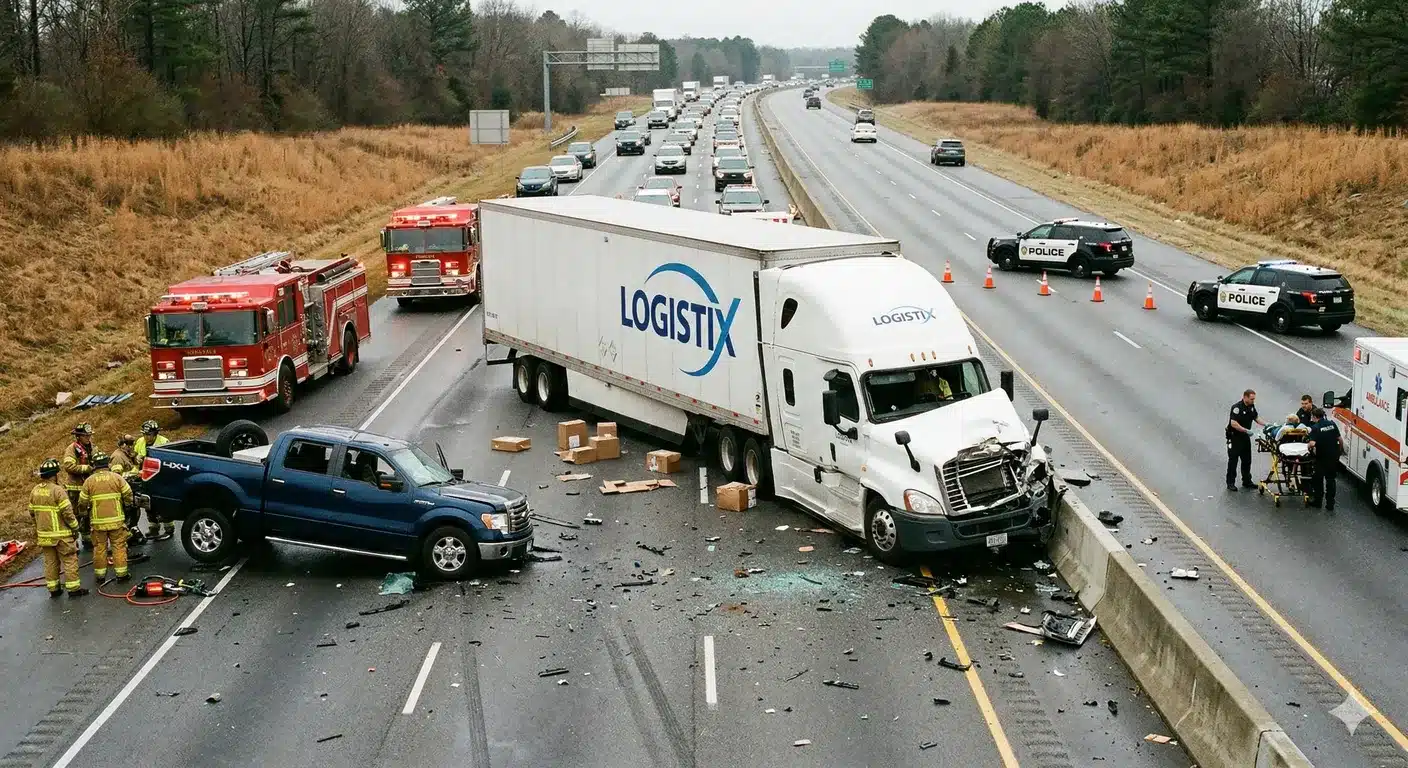
A client came to us after an 18-wheeler rear-ended their stopped vehicle in a highway construction zone near East Texas. The police report, frankly, didn’t help us — it cited our client for being stopped in an unclear position. A standard law firm might have taken that report at face value and started negotiations from a weak position.
We didn’t.
Within four hours, our rapid response team was at the scene. We photographed everything. We identified a surveillance camera mounted on a construction company trailer at the edge of the work zone. Within six hours, we had obtained that footage. It showed the truck approaching at high speed with no meaningful braking effort until the last second. That footage would have been recorded over within 24 to 48 hours. It was the case.
At the impound facility, our inspection found six of fourteen brake positions out of adjustment and a contaminated relay valve on the trailer, reducing trailer braking effectiveness by an additional 15%. Trailer ownership investigation revealed a separate leasing company — a second defendant with a $2 million liability policy we would never have identified if we’d only looked at the tractor.
Cell phone records showed a text message sent 38 seconds before impact. ECM data showed the truck traveling at 68 mph in a 60 mph construction zone, with no brake application until 0.8 seconds before the collision. ELD data showed the driver had been operating for 12.5 hours that day, exceeding the 11-hour federal limit. The post-accident drug test was administered six hours after the crash — four hours past the two-hour window required by federal regulation.
Our regulatory compliance investigation of the carrier found eight specific federal violations. The FMCSA’s Safety Measurement System showed the company had 47 roadside inspections in the previous two years resulting in 23 out-of-service violations. They had 12 accidents in three years. The company’s Vehicle Maintenance BASIC score was in “Alert” status. We pulled an internal email from a company mechanic who had told management that the fleet’s brakes were dangerously neglected and was told the repairs were too expensive.
Our demand package — six expert reports, 500 photographs, complete regulatory analysis, ECM data, cell records, maintenance history, life care plan, economic analysis, and the day-in-the-life video — went to three defendants.
The initial offer was $400,000. We rejected it.
We set a trial date. We completed all depositions. We finished all trial exhibits.
Two weeks before trial, the defendants offered $2,650,000 — the trucking company’s full policy limits plus $1.65 million from the trailer leasing company. We recommended acceptance. Our client agreed.
A standard PI firm handling that case — relying on the police report, missing the trailer owner, never obtaining the surveillance footage, never subpoenaing the cell records, never inspecting the brakes — might have settled for $400,000 to $600,000.
The difference was investigation.
What to Look for in a Truck Accident Lawyer in East Texas
If you or someone you love has been hurt in a commercial truck accident in East Texas, I want to give you a framework for evaluating the lawyers you speak with. Because not all of us approach these cases the same way, and the difference in outcomes is not subtle.
Ask the lawyer whether they have a rapid response capability and how quickly they can deploy investigators after a crash. Ask whether they understand the difference between a tractor’s brake system and a trailer’s brake system — and whether they inspect both. Ask how many experts they typically retain in a serious truck accident case and who those experts are. Ask to see examples of their demand packages. Ask about their trial record in truck accident cases specifically — not personal injury generally, but commercial vehicle cases. Ask whether they pursue trailer owners as separate defendants. Ask how quickly they send spoliation letters.
The answers to those questions will tell you more about the actual value of your representation than anything that gets printed on a billboard.
McKay Law serves 18-wheeler accident victims across East Texas — in Hopkins, Smith, Gregg, Rusk, Harrison, Hunt, and surrounding counties. We have offices in Sulfur Springs, Tyler, Longview, Greenville, and Dallas. We handle your case on a contingency basis — no fee unless we recover for you, and no separate fee for handling your property damage.
If you’ve been hurt in a truck accident on I-20, US-69, US-80, SH-154, or any other East Texas road, call us. Let’s talk about what actually happened — and what the full picture of accountability looks like for the people who caused it.
McKay Law PLLC | Call (903) INJURED | 903-465-8733
Available 24 hours a day, seven days a week.
McKayLawTx.com
McKay Law PLLC represents personal injury clients in Sulphur Springs, Tyler, Longview, Greenville, Dallas, and throughout East Texas, including Hopkins County, Smith County, Gregg County, Harrison County, Hunt County, Rusk County, Cherokee County, and beyond.